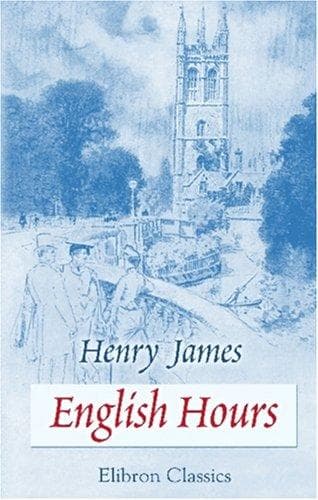
England -- Description and travel; James, Henry, 1843-1916 -- Travel -- England
The recital here, as every one remembers, is autobiographic; the old
battered, but considerably enriched, world-worn, but finely sharpened
Denis looks back upon a troubled life from the winter fireside and
places you, in his talkative and contagious way,—he is a practised
literary artist,—in possession of the story. We see him in a placid
port after many voyages, and have that amount of evidence—the most,
after all, that the most artless reader needs—as to the “happy”
side of the business. The evidence indeed is, for curiosity, almost
excessive, or at least premature; as he again and again puts it before
us that the companion of his later time, the admirable wife seated
there beside him, is nobody else at all, any hopes of a more tangled
skein notwithstanding, than the object of his infant passion, the
little French orphan, slightly younger than himself, who is brought so
promptly on the scene. The way in which this affects us as undermining
the “love-interest” bears remarkably on the specific question of the
subject of the book as the author would have expressed this subject
to his own mind. We get, to the moment the work drops, not a glimpse
of his central idea; nothing, if such had been his intention, was
in fact ever more triumphantly concealed. The darkness therefore is
intensified by our seeming to gather that, like the love-interest, at
all events, the “female interest” was not to have been largely invoked.
The narrator is in general, from the first, full of friendly hints,
in Thackeray’s way, of what is to come; but the chapters completed
deal only with his childish years, his wondrous boy-life at Winchelsea
and Rye, the public and private conditions of which—practically, in
the last century, the same for the two places—form the background for
this exposition. The southeastern counties, comparatively at hand,
were enriched at that period by a considerable French immigration,
the accession of Huguenot fugitives too firm in their faith to have
bent their necks to the dire rigours with which the revocation of the
Edict of Nantes was followed up. This corner of Sussex received—as
it had received in previous centuries—its forlorn contingent; to the
interesting origin of which many Sussex family names—losing, as it
were, their drawing but not their colour—still sufficiently testify.
Portions of the stranger race suffered, struggled, sank; other portions
resisted, took root and put forth branches, and Thackeray, clearly,
had found his rough material in some sketchy vision of one of these
obscure cases of troubled adjustment, which must often have been, for
difficulty and complexity, of the stuff of dramas. Such a case, for the
informed fancy, might indeed overflow with possibilities of character,
character reinforced, in especial, by the impression, gathered and
matured on the spot, of the two small ghosts of the Cinque Ports
family, the pair of blighted hill-towns that were once sea-towns and
Public-domain text, read in full here on John Shaqi.
Reviews
Reviews
No reviews yet
Be the first to share your thoughts on this work.
Elsewhere in the archive
Join the Discussion
Join the discussion
Sign in to leave a comment or review.
Sign InorCreate an account