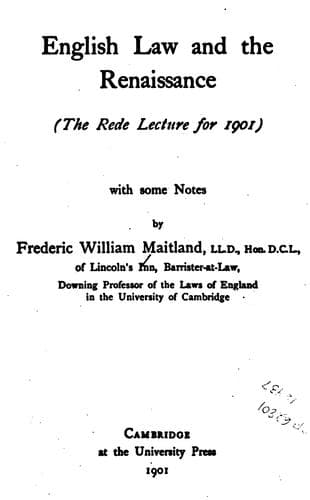
English Law and the Renaissance: The Rede Lecture for 1901Maitland, Frederic William
History
English Law and the Renaissance: The Rede Lecture for 1901
Maitland, Frederic William
Law -- England -- History; Renaissance -- England
[7] Rabelais, _Pantagruel_, liv. II., ch. X.: ‘Sottes et desraisonnables
raisons et ineptes opinions de Accurse, Balde, Bartole, de Castro, de
Imola, Hippolytus, Panorme, Bertachin, Alexander, Curtius et ces autres
vieux mastins, qui jamais n’entendirent la moindre loy des Pandectes,
et n’estoient que gros veaulx de disme, ignorans de tout ce qu’est
necessaire à l’intelligence des loix. Car (comme il est tout certain) ilz
n’avoient cognoissance de langue ny grecque, ny latine, mais seulement
de gothique et barbare.… Davantage, veu que les loix sont extirpées du
milieu de philosophie morale et naturelle, comment l’entendront ces folz,
qui ont par Dieu moins estudié en philosophie que ma mulle. Au regard
des lettres d’humanité et cognoissance des antiquités et histoires ilz
en estoient chargés comme un crapaud de plumes, et en usent comme un
crucifix d’un pifre, dont toutesfois les droits sont tous pleins, et
sans ce ne peuvent estre entenduz.’ W. F. Smith, _Rabelais_, vol. I., p.
257, translates the last sentence thus: ‘With regard to the cultivated
literature and knowledge of antiquities and history, they were as much
provided with those faculties as is a toad with feathers and have as
much use for them as a drunken heretic has for a crucifix.…’
[Sidenote: _Back to the texts!_]
[8] Stintzing, _Geschichte der deutschen Rechtswissenschaft_, vol. I., p.
96: ‘Man wird sich bewusst, dass nicht in der überlieferten Schulweisheit
das Wesen der Wissenschaft stecke; dass es auch hier gelte, dem Rufe des
Humanismus “zurück zu den Quellen!” zu folgen.’
[Sidenote: _The French school._]
[9] The greatest names appear to be those of François Duaren or more
correctly Le Douarin (1509-1559), Jacques Cujas (1522-1590), Hugues
Doneau (Donellus, 1527-1592), François Baudouin (Balduinus, 1520-1573),
François Hotman (1524-1591), Denis Godefroy (1549-1622), Jacques Godefroy
(1587-1652). Besides these there is Charles Du Moulin (Molinaeus,
1500-1566) whose chief work, however, was done upon French customary law,
and who in the study of Roman law represents a conservative tradition.
(Esmein, _Histoire du droit français_, ed. 2, p. 776.) Dareste (_Essai
sur François Hotman_, p. 2) marks the five years 1546-1551 as those in
which ‘nos quatre grands docteurs du seizième siècle’ (Hotman, Baudouin,
Cujas, Doneau) entered on their careers.
[Sidenote: _New life of the Corpus Juris._]
Public-domain text, read in full here on John Shaqi.
Reviews
Reviews
No reviews yet
Be the first to share your thoughts on this work.
Join the Discussion
Join the discussion
Sign in to leave a comment or review.
Sign InorCreate an account