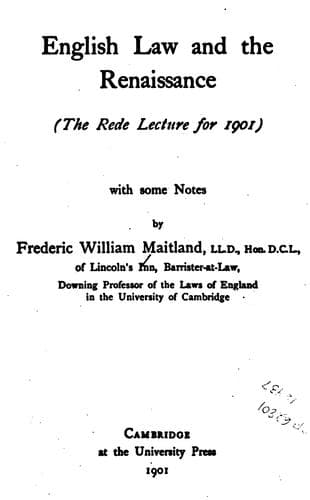
English Law and the Renaissance: The Rede Lecture for 1901Maitland, Frederic William
History
English Law and the Renaissance: The Rede Lecture for 1901
Maitland, Frederic William
Law -- England -- History; Renaissance -- England
[14] Injunctions of 1535, _Stat. Acad. Cantab._ p. 134: ‘Quare volumus
ut deinceps nulla legatur palam et publice lectio per academiam
vestram totam in iure canonico sive pontificio nec aliquis cuiuscunque
conditionis homo gradum aliquem in studio illius iuris pontificii
suscipiat aut in eodem inposterum promoveatur quovis modo.’ See
Mullinger, _Hist. Univ. Camb._ vol. I., p. 630; Cooper, _Annals of
Cambridge_, vol. I., p. 375; and for Oxford, Ellis, _Original Letters_,
Ser. II., vol. II., p. 60. In September 1535 Legh and Ap Ryce declare
that the canon laws are ‘profligate out of this realm.’ (_Letters and
Papers, Henry VIII._, vol. IX., p. 138.)
Despite a doubt suggested by Stubbs (_Seventeen Lectures_, ed. 3, p.
368), I cannot believe that the slightest hint of a degree in canon law
lurks at Cambridge in the title ‘Legum Doctor’ (LL.D.): not even ‘a
shadowy presentment of the double honour.’ See E. C. Clark, _Cambridge
Legal Studies_, 1888, pp. 56 ff., where that title is well explained. On
the continent a settled usage contrasted the _doctores legum_ and the
_doctores decretorum_. See e.g. Stintzing, _Geschichte der deutschen
Rechtswissenschaft_, vol. I., p. 25: ‘In Italien hatten die Legisten und
Decretisten verschiedene Schulen gebildet. In Deutschland waren sie zwar
zu einer Facultät vereinigt, bildeten jedoch lange Zeit zwei getrennte
Abtheilungen, von denen jede ihre eigenen akademischen Grade ertheilte.
Neben einander erscheinen die _Doctores Legum_ und _Doctores Decretorum_,
bis seit dem Anfang des 16. Jahrhunderts diese Scheidung schwindet und
die _Doctores utriusque iuris_ immer häufiger und endlich zur Regel
werden.’
[Sidenote: _Sir T. Smith._]
[15] See Mr Pollard’s life of Smith in _Dict. Nat. Biog._ Some important
facts, especially about his ordination, were revealed by J. G. Nichols,
in _Archaeologia_, XXXVIII. 98-127.
[Sidenote: _Smith and the new jurisprudence._]
[16] Smith says that when he first became a member of the senate at
Cambridge he bought the Digest and Code and certain works of Alciatus,
Zasius and Ferrarius. (See Mullinger, _History of the University
of Cambridge_, vol. II., p. 130.) Ferrarius is, I suppose, Arnaud
Ferrier, the master of Cujas. Mr Mullinger (p. 126) suggests that the
Spaniard Ludovico Vives while resident at Oxford may have propagated
dissatisfaction with the traditional teaching of Roman law.
[Sidenote: _The Court of Requests._]
[17] _Select Cases in the Court of Requests_ (Selden Society), 1898, p.
cxxiii. Mr Leadam’s introduction to this volume contains a great deal of
new and valuable matter concerning this important court. The title of the
‘masters of requests’ seems certainly to come hither from France. Just at
this time there was a good deal of borrowing in these matters: witness
the title of the ‘secretaries of state,’ which, it is said, spreads
outwards from Spain to make the tour of the world.
Public-domain text, read in full here on John Shaqi.
Reviews
Reviews
No reviews yet
Be the first to share your thoughts on this work.
Join the Discussion
Join the discussion
Sign in to leave a comment or review.
Sign InorCreate an account