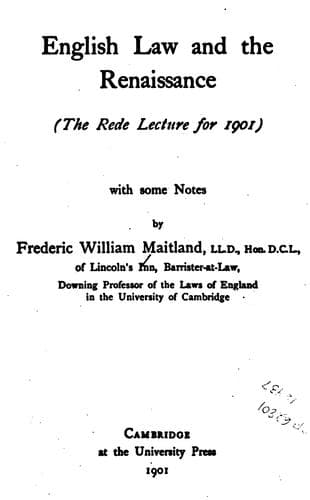
English Law and the Renaissance: The Rede Lecture for 1901Maitland, Frederic William
History
English Law and the Renaissance: The Rede Lecture for 1901
Maitland, Frederic William
Law -- England -- History; Renaissance -- England
There follows much more flattery of the king as a patron of learning of
every kind. ‘Iuris quidem civilis consulti facultas in hac republica
cum ad multos usus pernecessaria est, tum a principe nostro nequaquam
negligi aut levem haberi, vel hoc argumento esse potest, quod tam amplo
planeque regio stipendio et meam hic apud vos mediocritatem et alium
Oxonii disertum ac doctum virum ius hoc civile praelegere profiterique
voluit.’ And the study of the civil law is the high road to diplomatic
service. ‘Ius vero civile sic est commune ut cum ex Anglia discesseris,
nobiles, ignobiles, docti, indocti, sacerdotes etiam ac monachi cum
aliquod specimen eruditionis videri volunt exhibuisse, nihil fere aliud
perstrepunt quam quod ex hoc iure civili et pontificio sit depromptum.’
The king has wisely employed civilians in his many legations. There
follow compliments paid to Stephen Gardiner, Thomas Thirlby, William
Paget, Thomas Wriothesley, and Thomas Legh. On the whole, the professor
can hold out to his pupils the prospect of diplomatic employment, of
masterships in the chancery (‘sunt archiva Londini’), of practice in the
ecclesiastical courts and the court of admiralty, and besides this they
are to remember that the king is a great patron of learning. I do not see
any hint that knowledge of Roman law will help a man at the bar of the
ordinary English courts.
For more of the attempt to put new life into the study of Roman law
at Cambridge, see Mullinger, _op. cit._, vol. II., pp. 132 ff. Though
Somerset desired to see a great civil law college which should be a
nursery for diplomatists, the Edwardian or Protestant Reformation of
the church was in one way very unfavourable to the study of the civil
law. Bishoprics and deaneries were thenceforth reserved for divines, and
thus what had been the prizes of his profession were placed beyond the
jurist’s reach. Dr Nicholas Wotton (d. 1567), dean of Canterbury and
York, may be regarded as one of the last specimens of an expiring race.
Men who were not professionally learned, men like Sir Francis Bryan (d.
1550) and Sir Thomas Wyatt (d. 1542), had begun to compete with the
doctors for diplomatic missions and appointments. Also the chancellorship
of the realm had come within the ambition of the common lawyer, and
(though Bishop Goodrich may be one instance to the contrary) the policy
which would commit the great seal to the hands of a prelate was the
policy which would resist or reverse ecclesiastical innovations. Even
the mastership of the rolls, which had been held by doctors of Padua and
Bologna, fell to the common lawyers. Thomas Hannibal, master of the rolls
(1523-1527), must, one would think, have been an Italian, as were the
king’s Latin secretaries Andrea Ammonio and Pietro Vannes.
[Sidenote: _The heathenry of the Digest._]
Public-domain text, read in full here on John Shaqi.
Reviews
Reviews
No reviews yet
Be the first to share your thoughts on this work.
Join the Discussion
Join the discussion
Sign in to leave a comment or review.
Sign InorCreate an account