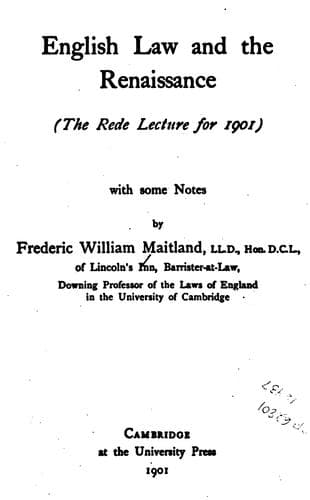
English Law and the Renaissance: The Rede Lecture for 1901 — John Shaqi
English Law and the Renaissance: The Rede Lecture for 1901Maitland, Frederic William
History
English Law and the Renaissance: The Rede Lecture for 1901
Maitland, Frederic William
Law -- England -- History; Renaissance -- England
[48] Commines attributes to Louis XI (_circ. an._ 1479) a project of
reducing to uniformity all the customs of France. Francis Bacon more
than once, when urging his schemes of law reform, referred to Louis’s
abortive project (Spedding, _Life and Letters_, VI. 66; VII. 362).
Commines’s story is not rejected by modern historians of French law.
The official redaction of the various ‘general customs’ (customs of
provinces) was commanded in 1453 by the ordinance of Montils-les-Tours.
Little, however, was done in this matter until the reigns of Charles
VIII and Louis XII. Many customs were redacted about the year 1510:
that of Orleans in 1509; that of Paris in 1510. This might be described
as a measure of codification: ‘elle fit, des coutumes, de véritables
_lois écrites_’ or, as we might say, statute law. (Esmein, _Histoire
du droit français_, 746 ff.; Viollet, _Histoire du droit français_,
142 ff.; Planiol, _Droit civil_, I. 12, 16). Then the Estates General
at Orleans in 1560 in effect demanded a general code: ‘Nous voulons
une foy, une loy, un roy’ said the prolocutor of the clergy. (Dareste,
_Hotman_, p. 20.) Both Du Moulin and Hotman recommended codification and
apparently thought that the task would not be difficult. (Viollet, _op.
cit._, p. 209; Dareste, _op. cit._, p. 21.) Then as to Germany:--‘An die
Klagen über die Verwirrung, in welche das Recht durch die scholastische
Wissenschaft gerathen ist, knüpft sich seit dem Anfange des 16.
Jahrhunderts regelmässig das Verlangen, der Kaiser möge als ein neuer
Justinian das gemeine Recht des Reichs zur Einfachheit und Klarheit
gesetzlich reformiren.… Das Verlangen nach einer Codification des
gemeinen Rechts zieht sich durch das ganze 16. Jahrhundert.’ (Stintzing,
_Geschichte der deutschen Rechtswissenschaft_, vol. I., pp. 58-9.) In
1532 after a prolonged effort the Empire actually came by a criminal
code, the so-called Carolina (Constitutio Carolina Criminalis; die
peinliche Halsgerichtsordnung Karls V.), but its operation was confined
by a clause which sanctioned the ever increasing particularism of the
various states by saving their ancient customs. (_Ibid._, pp. 621 ff.)
Within some of these states or ‘territories’ there was in the sixteenth
century a good deal of comprehensive legislation, amounting in some cases
to the publication of what we might call codes. A _Landrecht_ (to be
contrasted with _Reichsrecht_) was issued by the prince. His legislative
action was not always hampered by any assembly of Estates; he desired
uniformity within his territory; and the jurists who fashioned his
law-book were free to romanize as much as they pleased. The Würtemberg
Landrecht of 1555 issued by Duke Christopher, a prince well known to
Queen Elizabeth, is one of the chief instances (Stintzing, _op. cit._,
vol. I., pp. 537 ff.; Schröder, _Deutsche Rechtsgeschichte_, ed. 3,
pp. 886 ff.). The transmission of the cry for codification from Hotman
Public-domain text, read in full here on John Shaqi.
Reviews
Reviews
No reviews yet
Be the first to share your thoughts on this work.
Join the Discussion
Join the discussion
Sign in to leave a comment or review.
Sign InorCreate an account