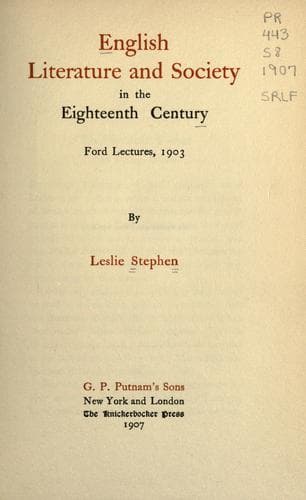
English Literature and Society in the Eighteenth CenturyStephen, Leslie
History
English Literature and Society in the Eighteenth Century
Stephen, Leslie
England -- Social life and customs -- 18th century; English literature -- 18th century -- History and criticism
He is not afraid of laying down an aesthetic theory. In a once
famous series of papers on the Imagination, he speaks with all the
authority of a recognised critic in discussing the merits of Chevy Chase
or of _Paradise Lost_; and in a series of Saturday papers he preaches
lay-sermons--which were probably preferred by many readers to the
official discourses of the following day. They contain those striking
poems (too few) which led Thackeray to say that he could hardly fancy a
'human intellect thrilling with a purer love and admiration than Joseph
Addison's.' Now, spite of the real charm which every lover of delicate
humour and exquisite urbanity must find in Addison, I fancy that the
_Spectator_ has come to mean for us chiefly Sir Roger de Coverley. It is
curious, and perhaps painful, to note how very small a proportion of the
whole is devoted to that most admirable achievement; and to reflect how
little life there is in much that in kindness of feeling and grace of
style is equally charming. One cause is obvious. When Addison talks of
psychology or aesthetics or ethics (not to speak of his criticism of
epic poetry or the drama), he must of course be obsolete in substance;
but, moreover, he is obviously superficial. A man who would speak upon
such topics now must be a grave philosopher, who has digested libraries
of philosophy. Addison, of course, is the most modest of men; he has not
the slightest suspicion that he is going beyond his tether; and that is
just what makes his unconscious audacity remarkable. He fully shares the
characteristic belief of the day, that the abstract problems are soluble
by common sense, when polished by academic culture and aided by a fine
taste. It is a case of _sancta simplicitas_; of the charming, because
perfectly unconscious, self-sufficiency with which the Wit, rejecting
pedantry as the source of all evil, thinks himself obviously entitled to
lay down the law as theologian, politician, and philosopher. His
audience are evidently ready to accept him as an authority, and are
flattered by being treated as capable of reason, not offended by any
assumption of their intellectual inferiority.
Public-domain text, read in full here on John Shaqi.
Reviews
Reviews
No reviews yet
Be the first to share your thoughts on this work.
Join the Discussion
Join the discussion
Sign in to leave a comment or review.
Sign InorCreate an account