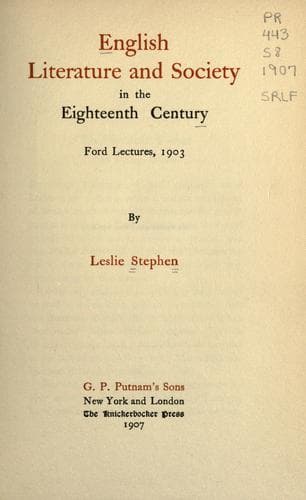
English Literature and Society in the Eighteenth Century — John Shaqi
English Literature and Society in the Eighteenth CenturyStephen, Leslie
History
English Literature and Society in the Eighteenth Century
Stephen, Leslie
England -- Social life and customs -- 18th century; English literature -- 18th century -- History and criticism
political struggles; he is putting in shape the practical philosophy
implied in the conversations at clubs and coffee-houses; he delights in
discussing such psychological problems as were suggested by the worldly
wisdom of Rochefoucauld, and he appreciates clever character sketches
such as those of La Bruyere. Both writers were favourites in England.
But he has become heartily tired of the old romance, and has not yet
discovered how to combine the interest of direct observation of man with
a thoroughly concrete form of presentation.
The periodical essay represents the most successful innovation of the
day; and, as I have suggested, because it represents the mode by which
the most cultivated writer could be brought into effective relation with
the genuine interests of the largest audience. Other writers used it
less skilfully, or had other ways of delivering their message to
mankind. Swift, for example, had already shown his peculiar vein. He
gives a different, though equally characteristic, side of the
intellectual attitude of the Wit. In the _Battle of the Books_ he had
assumed the pedantry of the scholar; in the _Tale of a Tub_ with amazing
audacity he fell foul of the pedantry of divines. His blows, as it
seemed to the Archbishops, struck theology in general; he put that right
by pouring out scorn upon Deists and all who were silly enough to
believe that the vulgar could reason; and then in his first political
writings began to expose the corrupt and selfish nature of
politicians--though at present only of Whig politicians. Swift is one of
the most impressive of all literary figures, and I will not even touch
upon his personal peculiarities. I will only remark that in one respect
he agrees with his friend Addison. He emphasises, of course, the aspect
over which Addison passes lightly; he scorns fools too heartily to treat
them tenderly and do justice to the pathetic side of even human folly.
But he too believes in culture--though he may despair of its
dissemination. He did his best, during his brief period of power, to
direct patronage towards men of letters, even to Whigs; and tried,
happily without success, to found an English Academy. His zeal was
genuine, though it expressed itself by scorn for dunces and hostility to
Grub Street. He illustrates one little peculiarity of the Wit. In the
society of the clubs there was a natural tendency to form minor cliques
of the truly initiated, who looked with sovereign contempt upon the
hackney author. One little indication is the love of mystifications, or
what were entitled 'bites.' All the Wits, as we know, combined to tease
the unlucky fortune-teller, Partridge, and to maintain that their
prediction of his death had been verified, though he absurdly pretended
to be still alive. So Swift tells us in the journal to Stella how he had
circulated a lie about a man who had been hanged coming to life again,
and how footmen are sent out to inquire into its success. He made a hit
Public-domain text, read in full here on John Shaqi.
Reviews
Reviews
No reviews yet
Be the first to share your thoughts on this work.
Join the Discussion
Join the discussion
Sign in to leave a comment or review.
Sign InorCreate an account