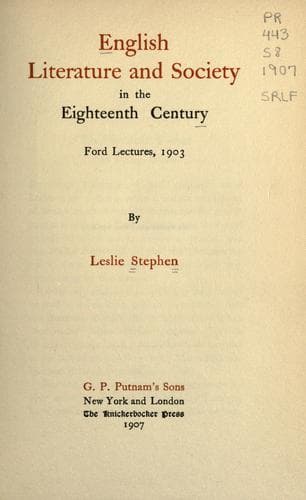
English Literature and Society in the Eighteenth CenturyStephen, Leslie
History
English Literature and Society in the Eighteenth Century
Stephen, Leslie
England -- Social life and customs -- 18th century; English literature -- 18th century -- History and criticism
That was the point. The enlightened critic sees that the work of art
embodies certain abstract rules; which may, and probably will--if he be
a man of powerful intellectual power, be rational, and suggest
instructive canons. But, as Pope sees, it does not follow that the
inverse process is feasible; that is, that you construct your poem
simply by applying the rules. To be a good cricketer you must apply
certain rules of dynamics; but it does not follow that a sound knowledge
of dynamics will enable you to play good cricket. Pope sees that
something more than an acceptance of M. Bossu's or Aristotle's canons is
requisite for the writer of a good epic poem. The something more,
according to him, appears to be learning and genius. It is certainly
true that at least genius must be one requisite. But then, there is the
further point. Will the epic poem, which was the product of certain
remote social and intellectual conditions, serve to express the thoughts
and emotions of a totally different age? Considering the difference
between Achilles and Marlborough, or the bards of the heroic age and the
wits who frequented clubs and coffee-houses under Queen Anne, it was at
least important to ask whether Homer and Pope--taking them to be alike
in genius--would not find it necessary to adopt radically different
forms. That is for us so obvious a suggestion that one wonders at the
tacit assumption of its irrelevance. Pope, indeed, by taking the _Iliad_
for a framework, a ready-made fabric which he could embroider with his
own tastes, managed to construct a singularly spirited work, full of
good rhetoric and not infrequently rising to real poetical excellence.
But it did not follow that an original production on the same lines
would have been possible. Some years later, Young complained of Pope for
being imitative, and said that if he had dared to be original, he might
have produced a modern epic as good as the _Iliad_ instead of a mere
translation. That is not quite credible. Pope himself tried an epic poem
too, which happily came to nothing; but a similar ambition led to such
works as Glover's _Leonidas_ and _The Epigoniad_ of the Scottish Homer
Wilkie. English poets as a rule seem to have suffered at some period of
their lives from this malady and contemplated Arthuriads; but the
constructional epic died, I take it, with Southey's respectable poems.
Public-domain text, read in full here on John Shaqi.
Reviews
Reviews
No reviews yet
Be the first to share your thoughts on this work.
Join the Discussion
Join the discussion
Sign in to leave a comment or review.
Sign InorCreate an account