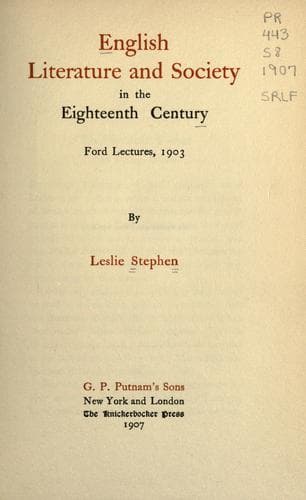
English Literature and Society in the Eighteenth Century — John Shaqi
English Literature and Society in the Eighteenth CenturyStephen, Leslie
History
English Literature and Society in the Eighteenth Century
Stephen, Leslie
England -- Social life and customs -- 18th century; English literature -- 18th century -- History and criticism
or painting; he can exert all his powers of forcible expression in a
form which will be thoroughly understood by his audience, and which
saves him, though at a certain cost, from the difficulties of trying to
reproduce the characteristics which are really incongruous.
There are disadvantages. In his time the learned M. Bossu was the
accepted authority upon the canons of criticism. Buckingham says he had
explained the 'mighty magic' of Homer. One doctrine of his was that an
epic poet first thinks of a moral and then invents a fable to illustrate
it. The theory struck Addison as a little overstated, but it is an
exaggeration of the prevalent view. According to Pope Homer's great
merit was his 'invention'--and by this he sometimes appears to imply
that Homer had even invented the epic poem. Poetry was, it seems, at a
'low pitch' in Greece in Homer's time, as indeed were other arts and
sciences. Homer, wishing to instruct his countrymen in all kinds of
topics, devised the epic poem: made use of the popular mythology to
supply what in the technical language was called his 'machinery';
converted the legends into philosophical allegory, and introduced
'strokes of knowledge from his whole circle of arts and sciences.' This
'circle' includes for example geography, rhetoric, and history; and the
whole poem is intended to inculcate the political moral that many evils
sprang from the want of union among the Greeks. Not a doubt of it! Homer
was in the sphere of poetry what Lycurgus was supposed to be in the
field of legislation. He had at a single bound created poetry and made
it a vehicle of philosophy, politics, and ethics. Upon this showing the
epic poem is a form of art which does not grow out of the historical
conditions of the period; but it is a permanent form of art, as good for
the eighteenth century as for the heroic age of Greece; it may be
adopted as a model, only requiring certain additional ornaments and
refinements to adapt it to the taste of a more enlightened period. Yet,
at the same time, Pope could clearly perceive some of the absurd
consequences of M. Bossu's view. He ridiculed that authority very keenly
in the 'Recipe to make an Epic Poem' which first appeared in the
_Guardian_, while he was at work upon his own translation. Bossu's
rules, he says, will enable us to make epic poems without genius or
reading; and he proceeds to show how you are to work your 'machines,'
and introduce your allegories and descriptions, and extract your moral
out of the fable at leisure, 'only making it sure that you strain it
sufficiently.'
Public-domain text, read in full here on John Shaqi.
Reviews
Reviews
No reviews yet
Be the first to share your thoughts on this work.
Join the Discussion
Join the discussion
Sign in to leave a comment or review.
Sign InorCreate an account