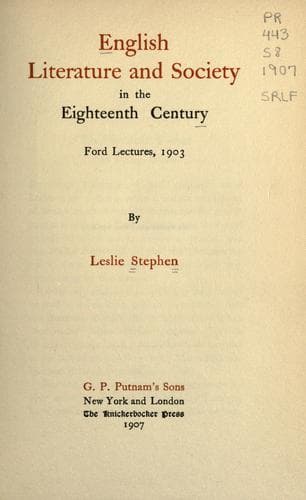
English Literature and Society in the Eighteenth CenturyStephen, Leslie
History
English Literature and Society in the Eighteenth Century
Stephen, Leslie
England -- Social life and customs -- 18th century; English literature -- 18th century -- History and criticism
We may consider, then, that any literary form, the drama, the epic poem,
the essay, and so forth, is comparable to a species in natural history.
It has, one may say, a certain organic principle which determines the
possible modes of development. But the line along which it will actually
develop depends upon the character and constitution of the literary
class which turns it to account, for the utterance of its own ideas; and
depends also upon the correspondence of those ideas with the most vital
and powerful intellectual currents of the time. The literary class of
Queen Anne's day was admirably qualified for certain formations: the
Wits leading the 'town,' and forming a small circle accepting certain
canons of taste, could express with admirable clearness and honesty the
judgment of bright common sense; the ideas which commend themselves to
the man of the world, and to a rationalism which was the embodiment of
common sense. They produced a literature, which in virtue of its
sincerity and harmonious development within certain limits could pass
for some time as a golden age. The aversion to pedantry limited its
capacity for the highest poetical creation, and made the imagination
subservient to the prosaic understanding. The comedy had come to adapt
itself to the tastes of the class which, instead of representing the
national movement, was composed of the more disreputable part of the
town. The society unable to develop it in the direction of refinement
left it to second-rate writers. It became enervated instead of elevated.
The epic and the tragic poetry, ceasing to reflect the really powerful
impulses of the day, were left to the connoisseur and dilettante man of
taste, and though they could write with force and dignity when
renovating or imitating older masterpieces, such literature became
effete and hopelessly artificial. It was at best a display of technical
skill, and could not correspond to the strongest passions and conditions
of the time. The invention of the periodical essay, meanwhile, indicated
what was a condition of permanent vitality. There, at least, the Wit was
appealing to a wide and growing circle of readers, and could utter the
real living thoughts and impulses of the time. The problem for the
coming period was therefore marked out. The man of letters had to
develop a living literature by becoming a representative of the ideas
which really interested the whole cultivated classes, instead of writing
merely for the exquisite critic, or still less for the regenerating and
obnoxious section of society. That indeed, I take it, is the general
problem of literature; but I shall have to trace the way in which its
solution was attempted in the next period.
III
(1714-1739)
Public-domain text, read in full here on John Shaqi.
Reviews
Reviews
No reviews yet
Be the first to share your thoughts on this work.
Join the Discussion
Join the discussion
Sign in to leave a comment or review.
Sign InorCreate an account