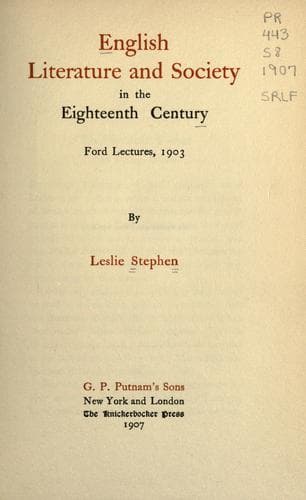
English Literature and Society in the Eighteenth CenturyStephen, Leslie
History
English Literature and Society in the Eighteenth Century
Stephen, Leslie
England -- Social life and customs -- 18th century; English literature -- 18th century -- History and criticism
The death of Queen Anne opens a new period in the history of literature
and of politics. Under the first Georges we are in the very heart of the
eighteenth century; the century, as its enemies used to say, of coarse
utilitarian aims, of religious indifference and political corruption;
or, as I prefer to say, the century of sound common sense and growing
toleration, and of steady social and industrial development.
To us, to me at least, it presents something pleasant in retrospect.
There were then no troublesome people with philanthropic or political or
religious nostrums, proposing to turn the world upside down and
introduce an impromptu millennium. The history of periods when people
were cutting each other's throats for creeds is no doubt more exciting;
but we, who profess toleration, ought surely to remember that you
cannot have martyrs without bigots and persecutors; and that
fanaticism, though it may have its heroic aspects, has also a very ugly
side to it. At any rate, we who come after a century of revolutionary
changes, and are often told that the whole order of things may be upset
by some social earthquake, look back with regret to the days of quiet
solid progress, when everything seemed to have settled down to a quiet,
stable equilibrium. Wealth and comfort were growing--surely no bad
things; and John Bull--he had just received that name from
Arbuthnot--was waxing fat and complacently contemplating his own
admirable qualities. It is the period of the composition of 'Rule
Britannia' and 'The Roast Beef of Old England,' and of the settled
belief that your lusty, cudgel-playing, beer-drinking Briton was worth
three of the slaves who ate frogs and wore wooden shoes across the
Channel. The British constitution was the embodiment of perfect wisdom,
and, as such, was entitled to be the dread and envy of the world. To the
political historian it is the era of Walpole; the huge mass of solid
common sense, who combined the qualities of the sturdy country squire
and the thorough man of business; whose great aim was to preserve the
peace; to keep the country as much as might be out of the continental
troubles which it did not understand, and in which it had no concern;
and to carry on business upon sound commercial principles. It is of
course undeniable that his rule not only meant regard for the solid
material interests of the country, but too often appealed to the
interests of the ruling class. Philosophical historians who deal with
the might-have-been may argue that a man of higher character might have
worked by better means and have done something to purify the political
atmosphere. Walpole was not in advance of his day; but it is at least
too clear to need any exposition that under the circumstances corruption
was inevitable. When the House of Commons was the centre of political
authority, when so many boroughs were virtually private property, when
men were not stirred to the deeper issues by any great constitutional
Public-domain text, read in full here on John Shaqi.
Reviews
Reviews
No reviews yet
Be the first to share your thoughts on this work.
Join the Discussion
Join the discussion
Sign in to leave a comment or review.
Sign InorCreate an account