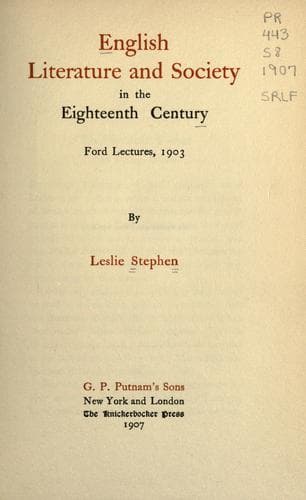
English Literature and Society in the Eighteenth CenturyStephen, Leslie
History
English Literature and Society in the Eighteenth Century
Stephen, Leslie
England -- Social life and customs -- 18th century; English literature -- 18th century -- History and criticism
struggle--party government had to be carried on by methods which
involved various degrees of jobbery and bribery. The disease was
certainly not peculiar to Walpole's age; though perhaps the symptoms
were more obvious and avowed more bluntly than usual. As Walpole's
masterful ways drove his old allies into opposition, they denounced the
system and himself; but unfortunately although they claimed to be
patriots and patterns of political virtue, they were made pretty much of
the same materials as the arch-corrupter. When the 'moneyed men,' upon
whom he had relied, came to be in favour of a warlike policy and were
roused by the story of Captain Jenkins' ear, Walpole fell, but no reign
of purity followed. The growing dissatisfaction, however, with the
Walpolean system implied some very serious conditions, and the cry
against corruption, in which nearly all the leading writers of the time
joined, had a very serious significance in literature and in the growth
of public opinion.
First, however, let me glance at the change as it immediately affected
the literary organ. The old club and coffee-house society broke up with
remarkable rapidity. While Oxford was sent to the Tower, and Bolingbroke
escaped to France, Swift retired to Dublin, and Prior, after being
imprisoned, passed the remainder of his life in retirement. Pope settled
down to translating Homer, and took up his abode at Twickenham, outside
the exciting and noisy London world in which the poor invalid had been
jostled. Addison soared into the loftier regions of politics and
married his Countess, and ceased to preside at Buttons'. Steele held on
for a time, but in declining prosperity and diminished literary
activity, till his retirement to Wales. No one appeared to fill the gaps
thus made in the ranks either of the Whigs' or the Tories' section of
literature. The change was obviously connected with the systematic
development of the party system. Swift bitterly denounced Walpole for
his indifference to literature! 'Bob the poet's foe' was guided by other
motives in disposing of his patronage. Places in the Customs were no
longer to be given to writers of plays or complimentary epistles in
verse, or even to promising young politicians, but to members of
parliament or the constituents in whom they were interested. The
placemen, who were denounced as one of the great abuses of the time,
were rewarded for voting power not for literary merit. The patron,
therefore, was disappearing; though one or two authors, such as Congreve
and Gay, might be still petted by the nobility; and Young somehow got a
pension out of Walpole, probably through Bubb Dodington, the very
questionable parson who still wished to be a Maecenas. Meanwhile there
was a compensation. The bookseller was beginning to supersede the
patron. Tonson and Lintot were making fortunes; the first Longman was
founding the famous firm which still flourishes; and the career of the
Public-domain text, read in full here on John Shaqi.
Reviews
Reviews
No reviews yet
Be the first to share your thoughts on this work.
Join the Discussion
Join the discussion
Sign in to leave a comment or review.
Sign InorCreate an account