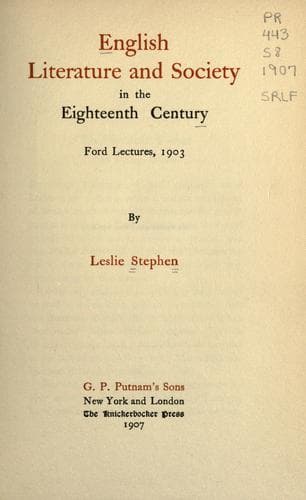
English Literature and Society in the Eighteenth CenturyStephen, Leslie
History
English Literature and Society in the Eighteenth Century
Stephen, Leslie
England -- Social life and customs -- 18th century; English literature -- 18th century -- History and criticism
disreputable and piratical Curll shows that at least the demand for
miscellaneous literature was growing. The anecdotes of the misery of
authors, of the translators who lay three in a bed in Curll's garret, of
Samuel Boyse, who had reduced his clothes to a single blanket, and
Savage sleeping on a bulk, are sometimes adduced to show that literature
was then specially depressed. But there never was a time when authors of
dissolute habits were not on the brink of starvation, and the
authorities of the Literary Fund could give us contemporary
illustrations of the fact. The real inference is, I take it, that the
demand which was springing up attracted a great many impecunious
persons, who became the drudges of the rising class of booksellers. No
doubt the journalist was often in a degrading position. The press was
active in all political struggles. The great men, Walpole, Bolingbroke,
and Pulteney, wrote pamphlets or contributed papers to the _Craftsman_,
while they employed inferior scribes to do the drudgery. Walpole paid
large sums to the 'Gazetters,' whom Pope denounces; and men like
Amherst of the _Craftsman_ or Gordon of the _Independent Whig_, carried
on the ordinary warfare. The author by profession was beginning to be
recognised. Thomson and Mallet came up from Scotland during this period
to throw themselves upon literature; Ralph, friend of Franklin and
collaborator of Fielding, came from New England; and Johnson was
attracted from the country to become a contributor to the _Gentleman's
Magazine_, started by Cave in 1731--an event which marked a new
development of periodical literature. Though no one would then advise a
young man who could do anything else to trust to authorship (it would be
rash to give such advice now) the new career was being opened. There
were hack authors of all varieties. The successful playwright gained a
real prize in the lottery; and translations, satires, and essays on the
_Spectator_ model enabled the poor drudge to make both ends meet, though
too often in bondage to his employer to be, as I take it, better off
than in the previous period, when the choice lay between risking the
pillory and selling yourself as a spy.
Public-domain text, read in full here on John Shaqi.
Reviews
Reviews
No reviews yet
Be the first to share your thoughts on this work.
Join the Discussion
Join the discussion
Sign in to leave a comment or review.
Sign InorCreate an account