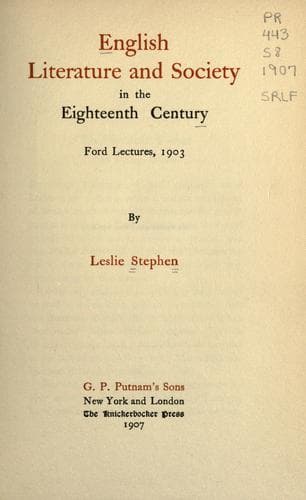
English Literature and Society in the Eighteenth CenturyStephen, Leslie
History
English Literature and Society in the Eighteenth Century
Stephen, Leslie
England -- Social life and customs -- 18th century; English literature -- 18th century -- History and criticism
Before considering the effect produced under the changed conditions, I
must note briefly the intellectual position. The period was that of the
culmination of the deist controversy. In the previous period the
rationalism of which Locke was the mouthpiece represented the dominant
tendency. It was generally held on all sides that there was a religion
of nature, capable of purely rational demonstration. The problem
remained as to its relation to the revealed religion and the established
creed. Locke himself was a sincere Christian, though he reduced the
dogmatic element to a minimum. Some of his disciples, however, became
freethinkers in the technical sense, and held that revelation was
needless, and that in point of fact no supernatural revelation had been
made. The orthodox, on the other hand, while admitting or declaring that
faith should be founded on reason, and that reason could establish a
'religion of nature,' admitted in various ways that a supernatural
revelation was an essential corollary or a useful addition to the simple
rational doctrine. The controversies which arose upon this issue, after
being carried on very vigorously for a time, caused less interest as
time went on, and were beginning to die out at the end of this period.
It is often said in explanation that deism or the religion of nature, as
then understood, was too vague and colourless a system to have any
strong vitality. It faded into a few abstract logical propositions which
had no relation to fact, and led to the optimistic formula, 'Whatever
is, is right,' which could in the long-run satisfy no one with any
strong perception of the darker elements of the world and human nature.
This view may be emphasised by the most remarkable writings of the
period. Butler's _Analogy_ (1736) has been regarded by many even of his
strongest opponents as triumphant against the deistical optimism, and
certainly emphasises the side of things to which that optimism is blind.
Hume's _Treatise of Human Nature_, at the end of the period (1739),
uttered the sceptical revolution which destroys the base of the
deistical system. Another writer is notable: William Law's _Serious
Call_ is one of the books which has made a turning-point in many men's
lives. It specially affected Samuel Johnson and John Wesley, and many of
those who sympathised more or less with Wesley's movement. Law was
driven by his sense of the aspects of the rationalist theories to adopt
a different position. He became a follower of Behmen, and his mysticism
ended by repelling the thoroughly practical Wesley, as indeed mysticism
in general seems to be uncongenial to the English mind. Law's position
shows a difficulty which was felt by others. It means that while he
holds that religion must be in the highest sense 'reasonable' it cannot
be (as another author put it) 'founded upon argument.' Faith must be
identified with the inner light, the direct voice of God to man, which
Public-domain text, read in full here on John Shaqi.
Reviews
Reviews
No reviews yet
Be the first to share your thoughts on this work.
Join the Discussion
Join the discussion
Sign in to leave a comment or review.
Sign InorCreate an account