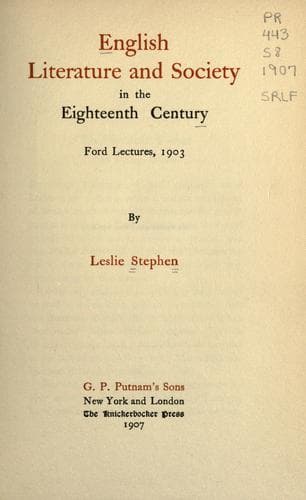
English Literature and Society in the Eighteenth CenturyStephen, Leslie
History
English Literature and Society in the Eighteenth Century
Stephen, Leslie
England -- Social life and customs -- 18th century; English literature -- 18th century -- History and criticism
more or less intention of preaching a sermon upon them. That is the
justification of the 'pure description' which Pope condemned in
principle, and which occupies the larger part of the poem. Thomson, when
he wrote the sermons, was still fresh from Edinburgh and from
Teviotdale. He had a real eye for scenery, and describes from
observation. The English Wits had not, it seems, annexed Scotland, and
Thomson had studied Milton and Spenser without being forced to look
through Pope's spectacles. Still he cannot quite trust himself. He is
still afraid, and not without reason, that pure description will fall
into flat prose, and tries to 'raise his diction'--in the phrase of the
day--by catching something of the Miltonic harmony and by speaking of
fish as 'finny tribes' and birds as 'the feathered people.' The fact,
however, that he could suspend his moralising to give realistic
descriptions at full length, and that they became the most interesting
parts of the poem, shows a growing interest in country life. The
supremacy of the town Wit is no longer unquestioned; and there is an
audience for the plain direct transcripts of natural objects for which
the Wit had been too dignified and polished. Thomson had thus the merit
of representing a growing sentiment--and yet he has not quite solved the
problem. His philosophy is not quite fused with his observation. To make
'Nature' really interesting you must have a touch of Wordsworthian
pantheism and of Shelley's 'pathetic fallacy.' Thomson's facts and his
commentary lie in separate compartments. To him, apparently, the
philosophy is more important than the simple description. His
masterpiece was to be the didactic and now forgotten poem on _Liberty_.
It gives an interesting application; for there already we have the
sentiment which was to become more marked in later years. 'Liberty'
crosses the Alps and they suggest a fine passage on the beauty of
mountains. Nature has formed them as a rampart for the homely republics
which worship 'plain Liberty'; and are free from the corruption typified
by Walpole. That obviously is the germ of the true Rousseau version of
Nature worship. On the whole, however, Nature, as interpreted by the
author of 'Rule Britannia,' is still very well satisfied with the
British Constitution and looks upon the Revolution of 1688 as the avatar
of the true goddess. 'Nature,' that is, has not yet come to condemn
civilisation in general as artificial and therefore corrupt. As in
practice, a lover of Nature did not profess to prefer the wilderness to
fields, and looked upon mountains rather as a background to the
nobleman's park than as a shelter for republics; so in politics it
reflected no revolutionary tendency but rather included the true British
system which has grown up under its protection. Nature has taken to
lecturing, but she only became frankly revolutionary with Rousseau and
misanthropic with Byron.
Public-domain text, read in full here on John Shaqi.
Reviews
Reviews
No reviews yet
Be the first to share your thoughts on this work.
Elsewhere in the archive
Join the Discussion
Join the discussion
Sign in to leave a comment or review.
Sign InorCreate an account