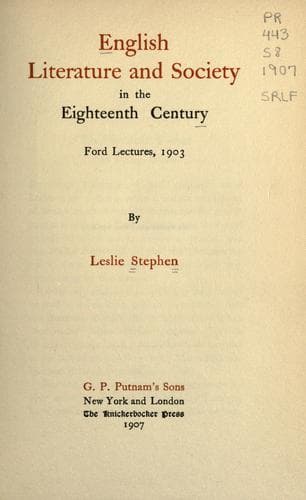
English Literature and Society in the Eighteenth CenturyStephen, Leslie
History
English Literature and Society in the Eighteenth Century
Stephen, Leslie
England -- Social life and customs -- 18th century; English literature -- 18th century -- History and criticism
I must touch one more characteristic. Pope, I have said, represents the
aristocratic development of literature. Meanwhile the purely plebeian
society was growing, and the toe of the clown beginning to gall the kibe
of the courtier. Pope's 'war with the dunces' was the historical symptom
of this most important social development. The _Dunciad_, which,
whatever its occasional merits, one cannot read without spasms both of
disgust and moral disapproval, is the literary outcome. Pope's morbid
sensibility perverts his morals till he accepts the worst of
aristocratic prejudices and treats poverty as in itself criminal. It led
him, too, to attack some worthy people, and among others the 'earless'
Defoe. Defoe's position is most significant. A journalist of supreme
ability, he had an abnormally keen eye for the interesting. No one could
feel the pulse of his audience with greater quickness. He had already
learned by inference that nothing interests the ordinary reader so much
as a straightforward narrative of contemporary facts. He added the
remark that it did not in the least matter whether the facts had or had
not happened; and secondly, that it saved a great deal of trouble to
make your facts instead of finding them. The result was the inimitable
_Robinson Crusoe_, which was, in that sense, a simple application of
journalistic methods, not a conscious attempt to create a new variety of
novel. Alexander Selkirk had very little to tell about his remarkable
experience; and so Defoe, instead of confining himself like the ordinary
interviewer to facts, proceeded to tell a most circumstantial and
elaborate lie--for which we are all grateful. He was doing far more than
he meant. Defoe, as the most thorough type of the English class to
which he belonged, could not do otherwise than make his creation a
perfect embodiment of his own qualities. _Robinson Crusoe_ became, we
know, a favourite of Rousseau, and has supplied innumerable
illustrations to writers on Political Economy. One reason is that Crusoe
is the very incarnation of individualism: thrown entirely upon his own
resources, he takes the position with indomitable pluck; adapts himself
to the inevitable as quietly and sturdily as may be; makes himself
thoroughly at home in a desert island, and, as soon as he meets a
native, summarily annexes him, and makes him thoroughly useful. He comes
up smiling after many years as if he had been all the time in a shop in
Cheapside without a hair turned. This exemplary person not only embodies
the type of middle class Briton but represents his most romantic
aspirations. In those days the civilised world was still surrounded by
the dim mysterious regions, where geographers placed elephants instead
of towns, but where the adventurous Briton was beginning to push his way
into strange native confines and to oust the wretched foreigner, Dutch,
French, Spanish, and Portuguese, who had dared to anticipate him.
Public-domain text, read in full here on John Shaqi.
Reviews
Reviews
No reviews yet
Be the first to share your thoughts on this work.
Elsewhere in the archive
Join the Discussion
Join the discussion
Sign in to leave a comment or review.
Sign InorCreate an account