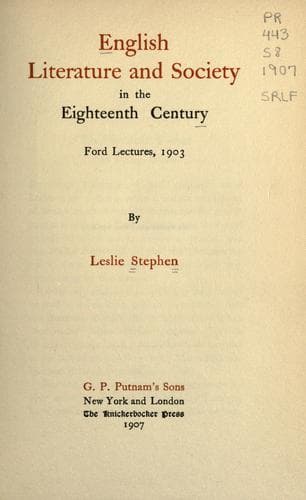
English Literature and Society in the Eighteenth CenturyStephen, Leslie
History
English Literature and Society in the Eighteenth Century
Stephen, Leslie
England -- Social life and customs -- 18th century; English literature -- 18th century -- History and criticism
career in 1738, and the rapid growth of his following is a familiar
proof on the one side of the indolence of the established authorities,
and on the other of the strength of the demand for reform in classes to
which he appealed. If, that is, the clergy were not up to their duties,
Wesley's success shows that there was a strong sense of existing moral
and social evils which only required an energetic leader to form a
powerful organisation. I need not attempt to inquire into the causes of
the Wesleyan and Evangelical movement, but must note one
characteristic--it had not an intellectual but a sound moral origin.
Wesley takes his creed for granted, and it was the creed, so far as they
had one, of the masses of the nation. He is shocked by perjury,
drunkenness, corruption, and so forth, but has not seriously to meet
scepticism of the speculative variety. If Wesley did not, like the
leader of another Oxford movement, feel bound to clear up the logical
basis of his religious beliefs, he had of course to confront deism, but
could set it down as a mere product of moral indifference. When Hartley,
like Butler, speaks of the general unbelief of the day, he was no doubt
correct within limits. In the upper social sphere the tone was
sceptical. Not only Bolingbroke but such men as Chesterfield and Walpole
were indifferent or contemptuous. They were prepared to go with
Voltaire's development of the English rationalism. But the English
sceptic of the upper classes was generally a Gallio. He had no desire to
propagate his creed, still less to attack the Church, which was a
valuable part of his property; it never occurred to him that scepticism
might lead to a political as well as an ecclesiastical revolution.
Voltaire was not intentionally destructive in politics, whatever the
real effect of his teaching; but he was an avowed and bitter enemy of
the Church and the orthodox creed. Hume, the great English sceptic, was
not only a Tory in politics but had no desire to affect the popular
belief. He could advise a clergyman to preach the ordinary doctrines,
because it was paying far too great a compliment to the vulgar to be
punctilious about speaking the truth to them. A similar indifference is
characteristic of the whole position. The select classes were to be
perfectly convinced that the accepted creed was superstitious; but they
were not for that reason to attack it. To the statesman, as Gibbon was
to point out, a creed is equally useful, true or false; and the English
clergy, though bound to use orthodox language, were far too well in hand
to be regarded as possible persecutors. Even in Scotland they made no
serious attempt to suppress Hume; he had only to cover his opinions by
some decent professions of belief. One symptom of the general state of
mind is the dying out of the deist controversies. The one great divine,
according to Brown's _Estimate_, was Warburton, the colossus, he says,
who bestrides the world: and Warburton, whatever else he may have been,
Public-domain text, read in full here on John Shaqi.
Reviews
Reviews
No reviews yet
Be the first to share your thoughts on this work.
Elsewhere in the archive
Join the Discussion
Join the discussion
Sign in to leave a comment or review.
Sign InorCreate an account