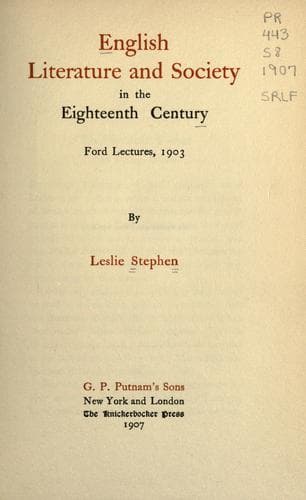
English Literature and Society in the Eighteenth CenturyStephen, Leslie
History
English Literature and Society in the Eighteenth Century
Stephen, Leslie
England -- Social life and customs -- 18th century; English literature -- 18th century -- History and criticism
was certainly of all divines the one whose argument is most palpably
fictitious, if not absolutely insincere. He marks, however, the tendency
of the argument to become historical. Like a much acuter writer, Conyers
Middleton, he is occupied with the curious problem: how do we reconcile
the admission that miracles never happen with the belief that they once
happened?--or are the two beliefs reconcilable? That means, is history
continuous? But it also means that the problems of abstract theology
were passing out of sight, and that speculation was turning to the
historical and scientific problems. Hartley was expounding the
association principle which became the main doctrine of the empirical
school, and Hume was teaching ethics upon the same basis, and turning
from speculation to political history. The main reason of this
intellectual indifference was the social condition under which the
philosophical theory found no strong current of political discontent
with which to form an alliance. The middle classes, which are now
growing in strength and influence, had been indifferent to the
discussions going on above their heads. The more enlightened clergy had,
of course, been engaged in the direct controversy, and had adopted a
kind of mild common-sense rationalism which implied complete
indifference to the dogmatic disputes of the preceding century. The
Methodist movement produced a little revival of the Calvinist and
Arminian controversy. But the beliefs of the great mass of the
population were not materially affected: they held by sheer force of
inertia to the old traditions, and still took themselves to be good
orthodox Protestants, though they had been unconsciously more affected
by the permeation of rationalism than they realised.
Public-domain text, read in full here on John Shaqi.
Reviews
Reviews
No reviews yet
Be the first to share your thoughts on this work.
Elsewhere in the archive
Join the Discussion
Join the discussion
Sign in to leave a comment or review.
Sign InorCreate an account