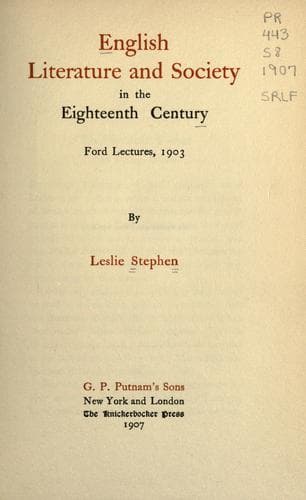
English Literature and Society in the Eighteenth CenturyStephen, Leslie
History
English Literature and Society in the Eighteenth Century
Stephen, Leslie
England -- Social life and customs -- 18th century; English literature -- 18th century -- History and criticism
One remarkable book marks the opening of the period. The first part of
Young's _Night Thoughts_ appeared in 1742, and the poem at once acquired
a popularity which lasted at least through the century. Young had been
more or less associated with the Addison and Pope circles, in the later
part of Queen Anne's reign. He had failed to obtain any satisfactory
share of the patronage which came to some of his fellows. He is still a
Wit till he has to take orders for a college living as the old Wits'
circle is decaying. He tried with little success to get something by
attaching himself to some questionable patrons who were induced to carry
on the practice, and the want of due recognition left him to the end of
his life as a man with a grievance. He had tried poetical epistles, and
satires, and tragedies with undeniable success and had shown undeniable
ability. Yet somehow or other he had not, one may say, emerged from the
second class till in the _Night Thoughts_ he opened a new vein which
exactly met the contemporary taste. The success was no doubt due to some
really brilliant qualities, but I need not here ask in what precise rank
he should be placed, as an author or a moralist. His significance for us
is simple. The _Night Thoughts_, as he tells us, was intended to supply
an omission in Pope's _Essay on Man_. Pope's deistical position excluded
any reference to revealed religion, to posthumous rewards and penalties,
and expressed an optimistic philosophy which ignored the corruption of
human nature. Young represents a partial revolt against the domination
of the Pope circle. He had always been an outsider, and his life at
Oxford had, you may perhaps hope, preserved his orthodoxy. He writes
blank verse, though evidently the blank verse of a man accustomed to the
'heroic couplets'; he uses the conventional 'poetic diction'; he strains
after epigrammatic point in the manner of Pope, and the greater part of
his poem is an elaborate argumentation to prove the immortality of
man--chiefly by the argument from astronomy. But though so far accepting
the old method, his success in introducing a new element marks an
important change. He is elaborately and deliberately pathetic; he is
always thinking of death, and calling upon the readers to sympathise
with his sorrows and accept his consolations. The world taken by itself
is, he maintains, a huge lunatic asylum, and the most hideous of sights
is a naked human heart. We are, indeed, to find sufficient consolation
from the belief in immortality. How far Young was orthodox or logical or
really edifying is a question with which I am not concerned. The
appetite for this strain of melancholy reflection is characteristic.
Blair's _Grave_, representing another version of the sentiment, appeared
simultaneously and independently. Blair, like Thomson, living in
Scotland, was outside the Pope circle of wit, and had studied the old
English authors instead of Pope and Dryden. He negotiated for the
Public-domain text, read in full here on John Shaqi.
Reviews
Reviews
No reviews yet
Be the first to share your thoughts on this work.
Elsewhere in the archive
Join the Discussion
Join the discussion
Sign in to leave a comment or review.
Sign InorCreate an account