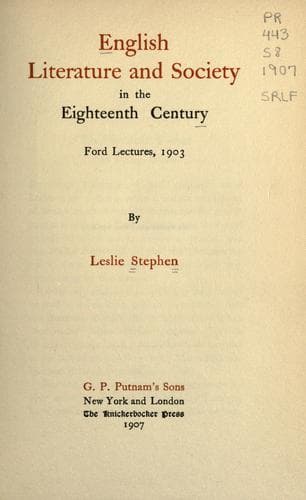
English Literature and Society in the Eighteenth CenturyStephen, Leslie
History
English Literature and Society in the Eighteenth Century
Stephen, Leslie
England -- Social life and customs -- 18th century; English literature -- 18th century -- History and criticism
and magazine regularly, and buy books enough to make it worth while to
supply the growing demand. The nobleman has ceased to consider the
patronage of authors as any part of his duty, and the tradition which
made him consider writing poetry as a proper accomplishment is dying
out. Since that time our aristocracy as such has been normally
illiterate. Peers--Byron, for example--have occasionally written books;
and more than one person of quality has, like Fox, kept up the interest
in classical literature which he acquired at a public school, and added
a charm to his parliamentary oratory. The great man, too, as I have
said, could take his chance in political writing, and occasionally
condescend to show his skill at an essay of the _Spectator_ model. But a
certain contempt for the professional writer is becoming characteristic,
even of men like Horace Walpole, who have a real taste for literature.
He is inclined to say, as Chesterfield put it in a famous speech, 'We,
my lords, may thank Heaven that we have something better than our brains
to depend upon.' As literature becomes more of a regular profession,
your noble wishes to show his independence of anything like a commercial
pursuit. Walpole can speak politely to men like Gibbon, and even to
Hume, who have some claim to be gentlemen as well as authors; but he
feels that he is condescending even to them, and has nothing but
contemptuous aversion for a Johnson, whose claim to consideration
certainly did not include any special refinement. Johnson and his circle
had still an odour of Grub street, which is only to be kept at a
distance more carefully because it is in a position of comparative
independence. Meanwhile, the author himself holds by the authority of
Addison and Pope. They, he still admits for the most part, represent the
orthodox church; their work is still taken to be the perfection of art,
and the canons which they have handed down have a prestige which makes
any dissenter an object of suspicion. Yet as the audience has really
changed, a certain change also makes itself felt in the substance and
the form of the corresponding literature.
Public-domain text, read in full here on John Shaqi.
Reviews
Reviews
No reviews yet
Be the first to share your thoughts on this work.
Elsewhere in the archive
Join the Discussion
Join the discussion
Sign in to leave a comment or review.
Sign InorCreate an account