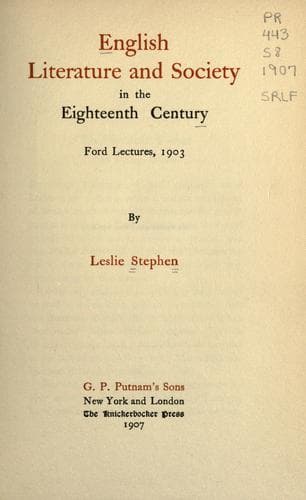
English Literature and Society in the Eighteenth CenturyStephen, Leslie
History
English Literature and Society in the Eighteenth Century
Stephen, Leslie
England -- Social life and customs -- 18th century; English literature -- 18th century -- History and criticism
triumphantly solved by _Tom Jones_. The story is no longer a mere series
of adventures, such as that which happened to Crusoe or Gil Blas,
connected by the fact that they happen to the same person; nor a
prolonged religious or moral tract, showing how evil will be punished
and virtue rewarded. It implies a dramatic situation which can be
developed without being hampered by the necessities of
stage-representation; and which can give full scope to a realistic
portrait of nature as it is under all the familiar circumstances of time
and place. This novel, which fulfilled those conditions, has ever since
continued to flourish; although a long time was to elapse before any one
could approach the merits of the first inventor. In all ages, I suppose,
the great artist, whether dramatist or epic poet or novelist, has more
or less consciously had the aim which Fielding implicitly claims for
himself; that is, to portray human nature. Every great artist, again,
must, in one sense, be thoroughly 'realistic.' The word has acquired an
irrelevant connotation: but I mean that his vision of the world must
correspond to the genuine living convictions of his time. He only ceases
to be a realist in that wide sense of the word when he deliberately
affects beliefs which have lost their vitality and uses the old
mythology, for example, as convenient machinery, when it has ceased to
have any real hold upon the minds of their contemporaries. So far Defoe
and Richardson and Fielding were perfectly right and deservedly
successful because they described the actual human beings whom they saw
before them, instead of regarding a setting forth of plain facts as
something below the dignity of the artist. Every new departure in
literature thrives in proportion as it abandons the old conventions
which have become mere survivals. Each of them, in his way, felt the
need of appealing to the new class of readers by direct portraiture of
the readers themselves, Fielding's merit is his thorough appreciation of
this necessity. He will give you men as he sees them, with perfect
impartiality and photographic accuracy. His hearty appreciation of
genuine work is characteristic. He admires Lillo, as I have said, for
giving George Barnwell instead of the conventional stage hero; and his
friend Hogarth, who was in pictorial art what he was in fiction, and
paints the 'Rake's Progress' without bothering about old masters or the
grand style; and he is enthusiastic about Garrick because he makes
Hamlet's fear of the ghost so natural that Partridge takes it for a
mere matter of course. Downright, forcible appeals to fact--contempt for
the artificial and conventional--are his strength, though they also
imply his weakness. Fielding, in fact, is the ideal John Bull; the 'good
buffalo,' as Taine calls him, the big, full-blooded, vigorous mass of
roast-beef who will stand no nonsense, and whose contempt for the
fanciful and arbitrary tends towards the coarse and materialistic. That
Public-domain text, read in full here on John Shaqi.
Reviews
Reviews
No reviews yet
Be the first to share your thoughts on this work.
Elsewhere in the archive
Join the Discussion
Join the discussion
Sign in to leave a comment or review.
Sign InorCreate an account