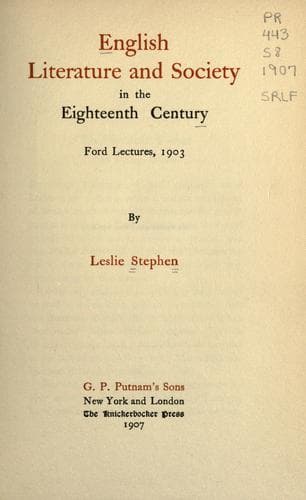
English Literature and Society in the Eighteenth CenturyStephen, Leslie
History
English Literature and Society in the Eighteenth Century
Stephen, Leslie
England -- Social life and customs -- 18th century; English literature -- 18th century -- History and criticism
corresponds to the contrast between Richardson and Fielding; and may
help to explain why the sentimentalism which Fielding despised yet
corresponded to a vague feeling after a real element of interest. But,
in truth, our criticism, I think, applies as much to Richardson as to
Fielding. Realism, taken in what I should call the right sense, is not
properly opposed to 'idealism'; it points to one of the two poles
towards which all literary art should be directed. The artist is a
realist so far as he deals with the actual life and the genuine beliefs
of his time; but he is an idealist so far as he sees the most essential
facts and utters the deepest and most permanent truths in his own
dialect. His work should be true to life and give the essence of actual
human nature, and also express emotions and thoughts common to the men
of all times. Now that is the weak side of the fiction of this period.
We may read _Clarissa Harlowe_ and _Tom Jones_ with unstinted
admiration; but we feel that we are in a confined atmosphere. There are
regions of thought and feeling which seem to lie altogether beyond their
province. Fielding, in his way, was a bit of a philosopher, though he is
too much convinced that Locke and Hoadley have said the last words in
theology and philosophy. Parson Adams is a most charming person in his
way, but his intellectual outlook is decidedly limited. That may not
trouble us much; but we have also the general feeling that we are living
in a little provincial society which somehow takes its own special
arrangements to be part of the eternal order of nature. The worthy
Richardson is aware that there are a great many rakes and infamous
persons about; but it never occurs to him that there can be any
speculation outside the Thirty-nine Articles; and though Fielding
perceives a great many abuses in the actual administration of the laws
and the political system, he regards the social order, with its squires
and parsons and attorneys as the only conceivable state of things. In
other words they, and I might add their successor Smollett, represent
all the prejudices and narrow assumptions of the quiet, respectable, and
in many ways worthy and domestically excellent, middle-class of the day;
which, on the whole, is determined not to look too deeply into awkward
questions, but to go along sturdily working out its own conceptions and
plodding along on well-established lines.
Public-domain text, read in full here on John Shaqi.
Reviews
Reviews
No reviews yet
Be the first to share your thoughts on this work.
Elsewhere in the archive
Join the Discussion
Join the discussion
Sign in to leave a comment or review.
Sign InorCreate an account