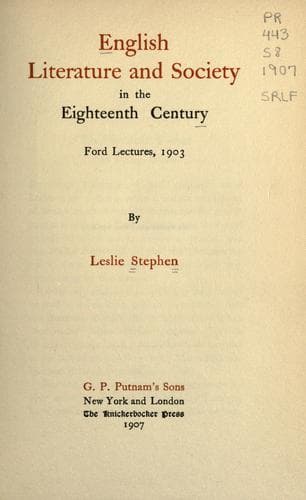
English Literature and Society in the Eighteenth CenturyStephen, Leslie
History
English Literature and Society in the Eighteenth Century
Stephen, Leslie
England -- Social life and customs -- 18th century; English literature -- 18th century -- History and criticism
He despises the old mythology and
the romantic symbolism because the theory was obviously absurd to a man
of the world, and to common sense. He believes that Homer was
deliberately conveying an allegory: and an allegory, whether of Homer or
of Spenser, is a roundabout and foolish way of expressing the truth. A
philosopher--and a poem is versified philosophy--should express himself
as simply and directly as possible. But, as soon as you begin to
appreciate the charm of ancient poetry, to be impressed by Scandinavian
Sagas or Highland superstition or Welsh bards, or allow yourself to
enjoy Spenser's idealised knights and ladies in spite of their total
want of common sense, or to appreciate _Paradise Lost_ although you no
longer accept Milton's scheme of theology, it becomes plain that the
specially poetic charm must consist in something else; that it can
appeal to the emotions and the imagination, though the doctrine which it
embodies is as far as possible from convincing your reason. The
discovery has a bearing upon what is called the love of Nature. Even
Thomson and his followers still take the didactic view of Nature. They
are half ashamed of their interest in mere dead objects, but can treat
skies and mountains as a text for discourses upon Natural Theology. But
Collins and Gray and Warton are beginning to perceive that the pleasure
which we receive from a beautiful prospect, whether of a mountain or of
an old abbey, is something which justifies itself and may be expressed
in poetry without tagging a special moral to its tail. Yet the sturdy
common sense represented by Fielding and Johnson is slow to accept this
view, and the romantic view of things has still for him a touch of
sentimentalism and affectation, and indicates the dilettante rather than
the serious thinker, and Pope still represents the orthodox creed though
symptoms of revolt are slowly showing themselves.
V
(1763-1788)
I now come to the generation which preceded the outbreak of the French
Revolution. Social and political movements are beginning to show
themselves in something of their modern form, and suggest most
interesting problems for the speculative historian. At the same time, if
we confine ourselves to the purely literary region, it is on the whole a
period of stagnation. Johnson is the acknowledged dictator, and Johnson,
the 'last of the Tories,' upholds the artistic canons of Dryden and
Pope, though no successor arises to produce new works at all comparable
with theirs. The school, still ostensibly dominant, has lost its power
of stimulating genius; and as yet no new school has arisen to take its
place. Wordsworth and Coleridge and Scott were still at college, and
Byron in the nursery, at the end of the period. There is a kind of
literary interregnum, though not a corresponding stagnation of
speculative and political energy.
Public-domain text, read in full here on John Shaqi.
Reviews
Reviews
No reviews yet
Be the first to share your thoughts on this work.
Elsewhere in the archive
Join the Discussion
Join the discussion
Sign in to leave a comment or review.
Sign InorCreate an account