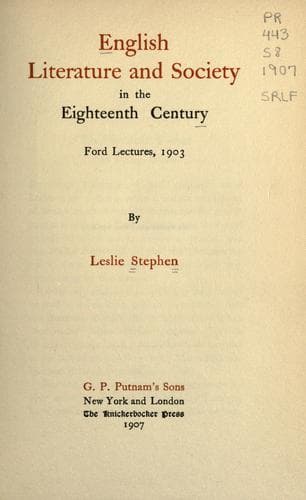
English Literature and Society in the Eighteenth CenturyStephen, Leslie
History
English Literature and Society in the Eighteenth Century
Stephen, Leslie
England -- Social life and customs -- 18th century; English literature -- 18th century -- History and criticism
literature, had still a certain sneaking regard for it. Addison, for
example, pays some grudging compliments to Chaucer and Spenser, though
he is careful to point out the barbarism of their taste. Pope, like all
poets, had loved Spenser in his boyhood and was well read in English
poetry. It was mighty simple of Rowe, he said, to try to write in the
style of Shakespeare, that is, in the style of a bad age. Yet he became
one of the earliest, and far from one of the worst, editors of
Shakespeare; and the growth of literary interest in Shakespeare is one
of the characteristic symptoms of the period. Pope had contemplated a
history of English poetry which was taken up by Gray and finally
executed by Warton. The development of an interest in literary history
naturally led to new departures. The poets of the period, Gray and
Collins and the Wartons, are no longer members of the little circle with
strict codes of taste. They are scholars and students not shut up within
the metropolitan area. There has been a controversy as to whether Gray's
unproductiveness is partly to be ascribed to his confinement to a narrow
and, it seems, to a specially stupid academical circle at Cambridge.
Anyway, living apart from the world of politicians and fine gentlemen,
he had the opportunity to become the most learned of English poets and
to be at home in a wide range of literature representing a great variety
of models. As the antiquary begins to rise to the historian, the
poetical merits recognised in the less regular canons become manifest.
Thomson, trying to write a half-serious imitation of Spenser, made his
greatest success by a kind of accident in the _Castle of Indolence_
(1748); Thomas Warton's Observation on the _Faery Queene_ in 1757 was an
illustration of the influence of historical criticism. I need not say
how Collins was interested by Highland superstition and Gray impressed
by Mallet's _Northern Antiquities_, and how in other directions the
labours of the antiquarian were beginning to provide materials for the
poetical imagination. Gray and Collins still held to the main Pope
principles. They try to be clear and simple and polished, and their
trick of personifying abstract qualities indicates the philosophical
doctrine which was still acceptable. The special principle, however,
which they were beginning to recognise is that indicated by Joseph
Warton's declaration in his _Essay on Pope_ (1757). 'The fashion of
moralising in verse,' he said, had been pushed too far, and he proceeded
to startle the orthodox by placing Spenser above Pope. The heresy gave
so much offence, it is said, that he did not venture to bring out his
second volume for twenty-five years. The point made by Warton marks, in
fact, the critical change. The weak side of the Pope school had been the
subordination of the imagination to the logical theory. Poetry tends to
become rhymed prose because the poet like the preacher has to expound
doctrines and to prove by argument.
Public-domain text, read in full here on John Shaqi.
Reviews
Reviews
No reviews yet
Be the first to share your thoughts on this work.
Elsewhere in the archive
Join the Discussion
Join the discussion
Sign in to leave a comment or review.
Sign InorCreate an account