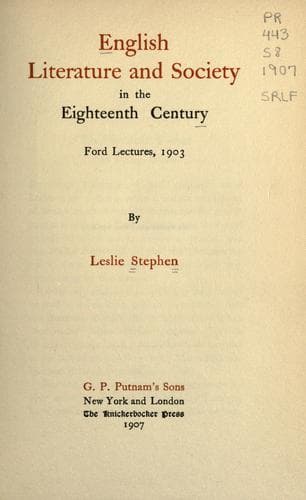
English Literature and Society in the Eighteenth CenturyStephen, Leslie
History
English Literature and Society in the Eighteenth Century
Stephen, Leslie
England -- Social life and customs -- 18th century; English literature -- 18th century -- History and criticism
In the political world again we have the first appearance of a
distinctly democratic movement. The struggle over Wilkes during the
earlier years began a contest which was to last through generations. The
American War of Independence emphasised party issues, and in some sense
heralded the French Revolution. I only note one point. The British
'Whig' of those days represented two impulses which gradually diverged.
There was the home-bred Whiggism of Wilkes and Horne Tooke--the Whiggism
of which the stronghold was in the city of London, with such heroes as
Lord Mayor Beckford, whose statue in the Guildhall displays him hurling
defiance at poor George III. This party embodies the dissatisfaction of
the man of business with the old system which cramped his energies. In
the name of liberty he demands 'self-government'; not greater vigour in
the Executive but less interference and a freer hand for the capitalist.
He believes in individual enterprise. He accepts the good old English
principle that the man who pays taxes should have a voice in spending
them; but he appeals not to an abstract political principle but to
tradition. The reformer, as so often happens, calls himself a restorer;
his political bible begins with the great charter and comes down to the
settlement of 1688. Meanwhile the true revolutionary
movement--represented by Paine and Godwin, appeals to the doctrines of
natural equality and the rights of man. It is unequivocally democratic,
and implies a growing cleavage between the working man and the
capitalists. It repudiates all tradition, and aspires to recast the
whole social order. Instead of proposing simply to diminish the
influence of government, it really tends to centralisation and the
transference of power to the lower classes. This genuine revolutionary
principle did not become conspicuous in England until it was introduced
by the contagion from France, and even then it remained an exotic. For
the present the Whig included all who opposed the Toryism of George III.
The difference between the Whig and the Radical was still latent, though
to be manifested in the near future. When the 'new Whigs,' as Burke
called them, Fox and Sheridan, welcomed the French Revolution in 1789,
they saw in it a constitutional movement of the English type and not a
thorough-going democratic movement which would level all classes, and
transfer the political supremacy to a different social stratum.
Public-domain text, read in full here on John Shaqi.
Reviews
Reviews
No reviews yet
Be the first to share your thoughts on this work.
Elsewhere in the archive
Join the Discussion
Join the discussion
Sign in to leave a comment or review.
Sign InorCreate an account