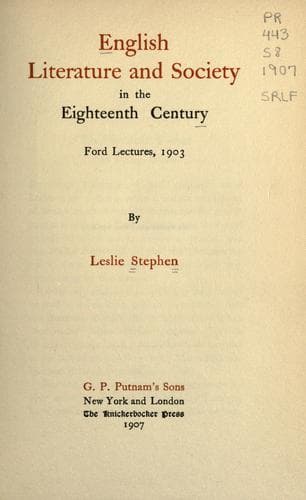
English Literature and Society in the Eighteenth CenturyStephen, Leslie
History
English Literature and Society in the Eighteenth Century
Stephen, Leslie
England -- Social life and customs -- 18th century; English literature -- 18th century -- History and criticism
This implies a dominant characteristic of the English political
movement. It was led, to use a later phrase, by Whigs not Radicals; by
men who fully accepted the British constitution, and proposed to remove
abuses, not to recast the whole system. The Whig wished to carry out
more thoroughly the platform accepted in 1688, to replace decaying by
sound timbers; but not to reconstruct from the base or to override
tradition by abstract and obsolete theories. His desire for change was
limited by a strong though implicit conservatism. This characteristic
is reflected in the sphere of speculative activity. Philosophy was
represented by the Scottish school whose watchword was common sense.
Reid opposed the scepticism of Hume which would lead, as he held, to
knocking his head against a post--a course clearly condemned by common
sense; but instead of soaring into transcendental and ontological
regions, he stuck to 'Baconian induction' and a psychology founded upon
experience. Hume himself, as I have said, had written for the
speculative few not for the vulgar; and he had now turned from the chase
of metaphysical refinements to historical inquiry. Interest in history
had become characteristic of the time. The growth of a stable, complex,
and continuous social order implies the formation of a corporate memory.
Masses of records had already been accumulated by antiquaries who had
constructed rather annals than history, in which the series of events
was given without much effort to arrange them in literary form or trace
the causal connection. In France, however, Montesquieu had definitely
established the importance of applying the historical method to
political problems; and Voltaire had published some of his brilliant
surveys which attempt to deal with the social characteristics as well
as the mere records of battles and conquests. Hume's _History_,
admirably written, gave Englishmen the first opportunity of enjoying a
lucid survey of the conspicuous facts previously embedded in ponderous
antiquarian phrases. Hume was one of the triumvirate who produced the
recognised masterpieces of contemporary literature. Robertson's theories
are, I take it, superseded: but his books, especially the _Charles V._,
not only gave broad surveys but suggested generalisations as to the
development of institutions, which, like most generalisations, were
mainly wrong, but stimulated further inquiry. Gibbon, the third of the
triumvirate, uniting the power of presenting great panoramas of history
with thorough scholarship and laborious research, produced the great
work which has not been, if it ever can be, superseded. A growing
interest in history thus led to some of the chief writings of the time,
as we can see that it was the natural outgrowth of the intellectual
position. The rapid widening of the historical horizon made even a bare
survey useful, and led to some recognition of the importance of guiding
and correcting political and social theory by careful investigation of
Public-domain text, read in full here on John Shaqi.
Reviews
Reviews
No reviews yet
Be the first to share your thoughts on this work.
Elsewhere in the archive
Join the Discussion
Join the discussion
Sign in to leave a comment or review.
Sign InorCreate an account