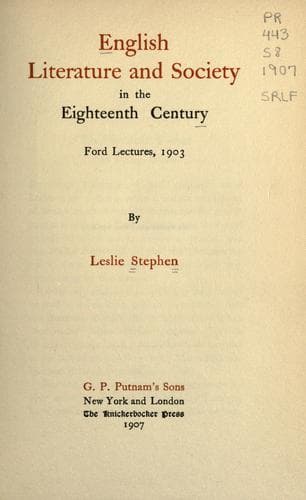
English Literature and Society in the Eighteenth CenturyStephen, Leslie
History
English Literature and Society in the Eighteenth Century
Stephen, Leslie
England -- Social life and customs -- 18th century; English literature -- 18th century -- History and criticism
After the _Deserted Village_ (1770) no striking work appeared
till Crabbe published his first volume (1781), and was followed by his
senior Cowper in 1782. Both of them employed the metre of Pope, though
Cowper took to blank verse; and Crabbe, though he had read and admired
Spenser, was to the end of his career a thorough disciple of Pope.
Johnson read and revised his _Village_, which was thoroughly in harmony
with the old gentleman's poetic creed. Yet both Cowper and Crabbe
stimulate what may be called in some sense 'a return to nature'; though
not in such a way as to announce a literary revolution. Each was
restrained by personal conditions. Cowper's poetical aims were
profoundly affected by his religious views. The movement which we call
Methodist was essentially moral and philanthropic. It agreed so far with
Rousseau's sentimentalism that it denounced the corruptions of the
existing order; but instead of attributing the evils to the departure
from the ideal state of nature, expressed them by the theological
doctrine of the corruption of the human heart. That implied in some
senses a fundamental difference. But there was a close coincidence in
the judgment of actual motives. Cowper fully agreed with Rousseau that
our rulers had become selfish and luxurious; that war was kept up to
satisfy the ambition of kings and courtiers; that vice flourished
because the aims of our rulers and teachers were low and selfish, and
that slavery was a monstrous evil supported by the greed of traders.
Brown's _Estimate_, he said, was thoroughly right as to our degeneracy,
though Brown had not perceived the deepest root of the evil. Cowper's
satire has lost its salt because he had retired too completely from the
world to make a telling portrait. But he succeeds most admirably when he
finds relief from the tortures of insanity by giving play to the
exquisite playfulness and tenderness which was never destroyed by his
melancholy. He delights us by an unconscious illustration of the simple
domestic life in the quiet Olney fields, which we see in another form in
the charming White of Selborne. He escapes from the ghastly images of
religious insanity when he has indulged in the innocent play of tender
and affectionate emotions, which finds itself revealed in tranquillising
scenery. The literary result is a fresh appreciation of 'Nature.' Pope's
Nature has become for him artificial and conventional. From a religious
point of view it represents 'cold morality,' and the substitution of
logical argumentation for the language of the heart. It suggests the
cynicism of the heartless fine gentleman who sneers at Wesley and
Bunyan, and covers his want of feeling by a stilted deism. Cowper tried
unsuccessfully to supersede Pope's _Homer_; in trying to be simple he
became bald; but he also tried most successfully to express with
absolute sincerity the simple and deep emotions of an exquisitely tender
character.
Public-domain text, read in full here on John Shaqi.
Reviews
Reviews
No reviews yet
Be the first to share your thoughts on this work.
Elsewhere in the archive
Join the Discussion
Join the discussion
Sign in to leave a comment or review.
Sign InorCreate an account