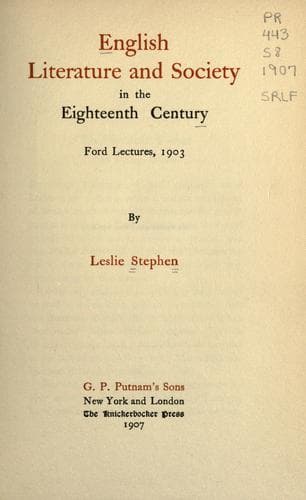
English Literature and Society in the Eighteenth CenturyStephen, Leslie
History
English Literature and Society in the Eighteenth Century
Stephen, Leslie
England -- Social life and customs -- 18th century; English literature -- 18th century -- History and criticism
He represents, no doubt, a kind of sham sentimentalism with an
insincerity which has disgusted many able critics. He was resolved to
attract notice at any price--by putting on cap and bells, and by the
pruriency which stains his best work. Like many contemporaries he was
reading old authors and turned them to account in a way which exposed
him to the charge of plagiarism. He valued them for their quaintness.
They enabled him to satisfy his propensity for being deliberately
eccentric which made Horace Walpole call _Tristram Shandy_ the 'dregs of
nonsense,' and the learned Dr. Farmer prophesied that in twenty years it
would be necessary to search antiquarian shops for a copy. Sterne's
great achievement, however, was not in the mere buffoonery but in the
passages where he continued the Addison tradition. Uncle Toby is a
successor of Sir Roger, and the famous death of Lefevre is told with
inimitable simplicity and delicacy of touch. Goldsmith and Sterne work
upon the old lines, but make use of the new motives and materials which
are beginning to interest readers, and which will in time call for
different methods of treatment.
I must briefly indicate one other point. The society of which Garrick
was a member, and which was both reading Shakespeare and seeing his
plays revived, might well seem fitted to maintain a drama. Goldsmith
complains of the decay of the stage, which he attributes partly to the
exclusion of new pieces by the old Shakespearian drama. On that point he
agrees as far as he dares with Voltaire. He ridiculed Home's _Douglas_,
one of the last tragedies which made even a temporary success, and which
certainly showed that the true impulse was extinct. But Goldsmith and
his younger contemporary Sheridan succeeded for a time in restoring
vigour to comedy. Their triumph over the sentimentalists Kelly and
Cumberland showed, as Johnson put it, that they could fill the aim of
the comedian, namely, making an audience merry. _She Stoops to Conquer_
and _The School for Scandal_ remain among genuine literary masterpieces.
They are revivals of the old Congreve method, and imply the growth of a
society more decent and free from the hard cynical brutality which
disgraced the earlier writers. I certainly cannot give a sufficient
reason why the society of Johnson and Reynolds, full of shrewd common
sense, enjoying humour, and with a literary social tradition, should not
have found other writers capable of holding up the comic mirror. I am
upon the verge of a discussion which seems to be endless, the causes of
the decay of the British stage. I must give it a wide berth, and only
note that, as a fact, Sheridan took to politics, and his mantle fell on
no worthy successor. The next craze (for which he was partly
responsible) was the German theatre of Kotzebue, which represented the
intrusion of new influences and the production of a great quantity of
rubbish. After Goldsmith the poetic impulse seems to have decayed
entirely.
Public-domain text, read in full here on John Shaqi.
Reviews
Reviews
No reviews yet
Be the first to share your thoughts on this work.
Elsewhere in the archive
Join the Discussion
Join the discussion
Sign in to leave a comment or review.
Sign InorCreate an account