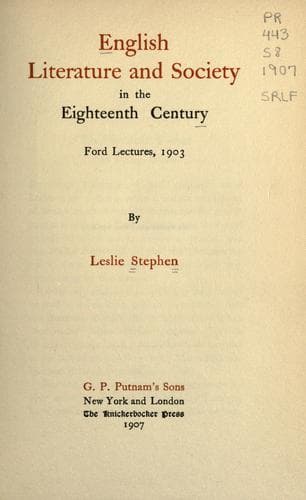
English Literature and Society in the Eighteenth CenturyStephen, Leslie
History
English Literature and Society in the Eighteenth Century
Stephen, Leslie
England -- Social life and customs -- 18th century; English literature -- 18th century -- History and criticism
To him Pope's metaphysical
system was mere foppery, and the denunciation of luxury mere cant. He
felt mere contempt for Goldsmith's flirtation with that vein of
sentiment. His dogged conservatism prevented him from recognising the
strength of the philosophical movements which were beginning to clothe
themselves in Rousseauism. Burke, if he condemned the revolutionary
doctrine as wicked, saw distinctly how potent a lesson it was becoming.
Johnson, showing the true British indifference, could treat the movement
with contempt--Hume's scepticism was a mere 'milking the bull'--a love
of paradox for its own sake--and Wilkes and the Whigs, though wicked in
intention, were simple and superficial dealers in big words. In the
literary application the same sturdy common sense was opposed to the
Pope tradition so far as that tradition opposed common sense.
Conventional diction, pastorals, and twaddle about Nature belonged to
the nonsensical side. He entirely sympathised with Crabbe's substitution
of the real living brutish clown for the unreal swain of Arcadia; that
is, for developing poetry by making it thoroughly realistic even at the
cost of being prosaic.
So far the tendency to realism was thoroughly congenial to the
matter-of-fact utilitarian spirit of the time, and was in some sense in
harmony with a 'return to Nature.' But it was unconsciously becoming
divorced from some of the great movements of thought, of which it failed
to perceive the significance. A new inspiration was showing itself, to
which critics have done at least ample justice. The growth of history
had led to renewed interest in much that had been despised as mere
curiosities or ridiculed as implying the barbarism of our ancestors. I
have already noticed the dilettantism of the previous generation, and
the interest of Gray and Collins and Warton and Walpole in antiquarian
researches. Gothic had ceased to be a simple term of reproach. The old
English literature is beginning to be studied seriously. Pope and
Warburton and Johnson had all edited Shakespeare; Garrick had given him
fresh popularity, and the first edition of _Old Plays_ by Dodsley
appeared in 1744. Similar studies were extending in many directions.
Mallet in his work upon Denmark (1755) gave a translation of the _Eddas_
which called attention to Scandinavian mythology. Bodmer soon
afterwards published for the first time the _Nibelungen Lied_.
Macpherson startled the literary world in 1762 by what professed to be
an epic poem from the Gaelic. Chatterton's career (1752-1770) was a
proof not only of unique poetical precocity, but of a singular facility
in divining the tastes of the literary world at the time. Percy's
_Reliques_ appeared in 1765. Percy, I may note, had begun oddly enough
by publishing a Chinese novel (1761), and a translation of Icelandic
poetry (1763). Not long afterwards Sir William Jones published
translations of Oriental poetry. Briefly, as historical, philological,
Public-domain text, read in full here on John Shaqi.
Reviews
Reviews
No reviews yet
Be the first to share your thoughts on this work.
Elsewhere in the archive
Join the Discussion
Join the discussion
Sign in to leave a comment or review.
Sign InorCreate an account