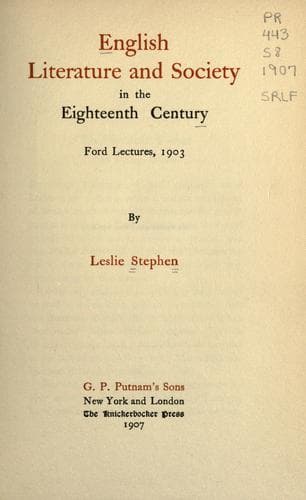
English Literature and Society in the Eighteenth CenturyStephen, Leslie
History
English Literature and Society in the Eighteenth Century
Stephen, Leslie
England -- Social life and customs -- 18th century; English literature -- 18th century -- History and criticism
and antiquarian research extended, the man of letters was also beginning
to seek for new 'motives,' and to discover merits in old forms of
literature. The importance of this new impulse cannot be over-estimated,
but it may be partly misinterpreted. It is generally described as a
foretaste of what is called the Romantic movement. The word is no doubt
very useful--though exceedingly vague. The historian of literature is
sometimes given to speak as though it meant the revelation of a new and
definite creed. He speaks, that is, like the historian of science, who
accepts Darwinism as the revelation of a new principle transfusing the
old conceptions, and traces the various anticipations, the seminal idea;
or like the Protestant theologian who used to regard Luther as having
announced the full truth dimly foreseen by Wicliff or the Albigenses.
Romanticism, that is, is treated as a single movement; while the men who
share traces of the taste are supposed to have not only foreseen the new
doctrine but to have been the actual originators. Yet I think that all
competent writers will also agree that Romanticism is a name which has
been applied to a number of divergent or inconsistent schools. It seems
to mean every impulse which tended to find the old clothing inadequate
for the new thoughts, which caused dissatisfaction with the old
philosophical and religious or political systems and aspirations, and
took a corresponding variety of literary forms. It is far too complex a
phenomenon to be summed up in any particular formula. The mischief is
that to take the literary evolution as an isolated phenomenon is to miss
an essential clue to such continuity and unity as it really possesses.
When we omit the social factor, the solidarity which exists between
contemporaries occupied with the same problem and sharing certain common
beliefs, each school appears as an independent unit, implying a
discontinuity or a simple relation of contrariety, and we explain the
succession by such a verbal phrase as 'reaction.' The real problem is,
what does the reaction mean? and that requires us to take into account
the complex and variously composed currents of thought and reason which
are seeking for literary expression. The popularity of _Ossian_ for
example, is a curious phenomenon. At the first sight we are disposed to
agree with Johnson that any man could write such stuff if he would
abandon his mind to it, and to add that if any one would write it no one
could read it. Yet we know that _Ossian_ appealed to the gigantic
intellects of Goethe and Napoleon. That is a symptom of deep
significance; _Ossian_ suited Goethe in the _Werther_ period and
Napoleon took it with him when he was dreaming of rivalling Alexander's
conquests in the East. We may perhaps understand why the gigantesque
pictures in _Ossian_ of the northern mountains and scenery--with all its
vagueness, incoherence, and bombast, was somehow congenial to minds
Public-domain text, read in full here on John Shaqi.
Reviews
Reviews
No reviews yet
Be the first to share your thoughts on this work.
Elsewhere in the archive
Join the Discussion
Join the discussion
Sign in to leave a comment or review.
Sign InorCreate an account