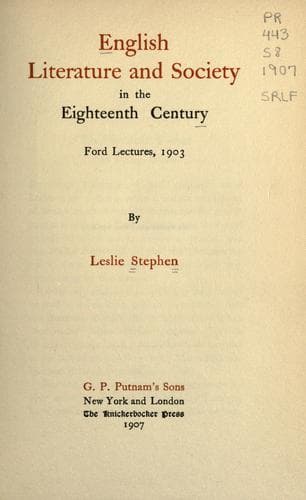
English Literature and Society in the Eighteenth CenturyStephen, Leslie
History
English Literature and Society in the Eighteenth Century
Stephen, Leslie
England -- Social life and customs -- 18th century; English literature -- 18th century -- History and criticism
This suggests the last remark which I have room to make. One
characteristic of the period is a growth of provincial centres of some
intellectual culture. As manufactures extended, and manufacturers began
to read, circles of some literary pretensions sprang up in Norwich,
Birmingham, Bristol, and Manchester; and most conspicuously in
Edinburgh. Though the Scot was coming south in numbers which alarmed
Johnson, there were so many eminent Scots at home during this time that
Edinburgh seems at least to have rivalled London as an intellectual
centre. The list of great men includes Hume and Adam Smith, Robertson
and Hailes and Adam Ferguson, Kames, Monboddo, and Dugald Stewart among
philosophers and historians; John Home, Blair, G. Campbell, Beattie, and
Henry Mackenzie among men of letters; Hutton, Black, Cullen, and
Gregory among scientific leaders. Scottish patriotism then, as at other
periods, was vigorous, and happily ceasing to be antagonistic to
unionist sentiment. The Scot admitted that he was touched by
provincialism; but he retained a national pride, and only made the
modest and most justifiable claim that he was intrinsically superior to
the Southron. He still preserved intellectual and social traditions, and
cherished them the more warmly, which marked him as a distinct member of
the United Kingdom. In Scotland the rapid industrial development had
given fresh life to the whole society without obliterating its
distinctive peculiarities. Song and ballad and local legends were still
alive, and not merely objects of literary curiosity. It was under such
conditions that Burns appeared, the greatest beyond compare of all the
self-taught poets. Now there can be no explanation whatever of the
occurrence of a man of genius at a given time and place. For anything we
can say, Burns was an accident; but given the genius, his relation was
clear, and the genius enabled him to recognise it with unequalled
clearness. Burns became, as he has continued, the embodiment of the
Scottish genius. Scottish patriotic feeling animates some of his
noblest poems, and whether as an original writer--and no one could be
more original--or as adapting and revising the existing poetry, he
represents the essential spirit of the Scottish peasant. I need not
point out that this implies certain limitations, and some failings worse
than limitation. But it implies also the spontaneous and masculine
vigour which we may call poetic inspiration of the highest kind. He had
of course read the English authors such as Addison and Pope. So far as
he tried to imitate the accepted form he was apt to lose his fire. He is
inspired when he has a nation behind him and is the mouthpiece of
sentiments, traditional, but also living and vigorous. He represents,
therefore, a new period. The lyrical poetry seemed to have died out in
England. It suddenly comes to life in Scotland and reaches unsurpassable
excellence within certain limits, because a man of true genius rises to
Public-domain text, read in full here on John Shaqi.
Reviews
Reviews
No reviews yet
Be the first to share your thoughts on this work.
Elsewhere in the archive
Join the Discussion
Join the discussion
Sign in to leave a comment or review.
Sign InorCreate an account