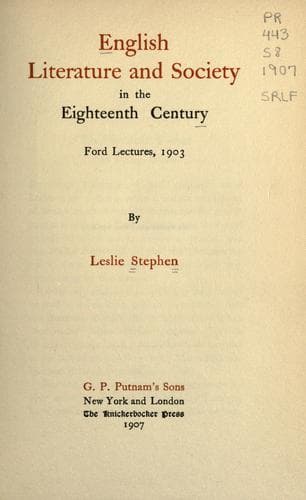
English Literature and Society in the Eighteenth CenturyStephen, Leslie
History
English Literature and Society in the Eighteenth Century
Stephen, Leslie
England -- Social life and customs -- 18th century; English literature -- 18th century -- History and criticism
utter the emotions of a people in their most natural form without
bothering about canons of literary criticism. The society and the
individual are in thorough harmony, and that, I take it, is the
condition of really great literature at all times.
This must suggest my concluding moral. The watchword of every literary
school may be brought under the formula 'Return to Nature': though
'Nature' receives different interpretations. To be natural, on the one
hand, is to be sincere and spontaneous; to utter the emotions natural to
you in the forms which are also natural, so far as the accepted canons
are not rules imposed by authority but have been so thoroughly
assimilated as to express your own instinctive impulses. On the other
side, it means that the literature must be produced by the class which
embodies the really vital and powerful currents of thought which are
moulding society. The great author must have a people behind him; utter
both what he really thinks and feels and what is thought and felt most
profoundly by his contemporaries. As the literature ceases to be truly
representative, and adheres to the conventionalism of the former period,
it becomes 'unnatural' and the literary forms become a survival instead
of a genuine creation. The history of eighteenth century literature
illustrates this by showing how as the social changes give new influence
to the middle classes and then to the democracy, the aristocratic class
which represented the culture of the opening stage is gradually pushed
aside; its methods become antiquated and its conventions cease to
represent the ideals of the most vigorous part of the population. The
return to Nature with Pope and Addison and Swift meant, get rid of
pedantry, be thoroughly rational, and take for your guide the bright
common sense of the Wit and the scholar. During Pope's supremacy the Wit
who represents the aristocracy produces some admirably polished work;
but the development of journalism and Grub Street shows that he is
writing to satisfy the popular interests so keenly watched by Defoe in
Grub Street. In the period of Richardson and Fielding Nature has become
the Nature of the middle-class John Bull. The old romances have become
hopelessly unnatural, and they will give us portraits of living human
beings, whether Clarissa or Tom Jones. The rationalism of the higher
class strikes them as cynical, and the generation which listens to
Wesley must have also a secular literature, which, whether sentimental
as with Richardson or representing common sense with Fielding, must at
any rate correspond to solid substantial matter-of-fact motives,
intelligible to the ordinary Briton of the time. In the last period, the
old literary conventions, though retaining their old literary prestige,
are becoming threadbare while preserving the old forms. Even the
Johnsonian conservatism implies hatred for cant, for mere foppery and
sham sentimentalism; and though it uses them, insists with Crabbe upon
Public-domain text, read in full here on John Shaqi.
Reviews
Reviews
No reviews yet
Be the first to share your thoughts on this work.
Elsewhere in the archive
Join the Discussion
Join the discussion
Sign in to leave a comment or review.
Sign InorCreate an account