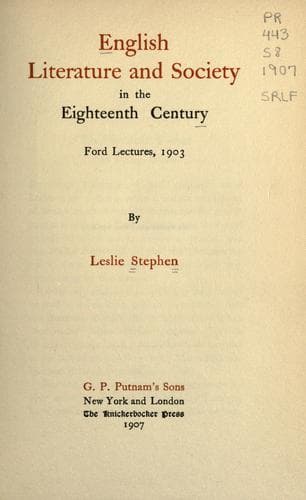
English Literature and Society in the Eighteenth CenturyStephen, Leslie
History
English Literature and Society in the Eighteenth Century
Stephen, Leslie
England -- Social life and customs -- 18th century; English literature -- 18th century -- History and criticism
Englishman to be affected by the philosophical movement of Germany. He
had been an ardent revolutionist in the days when he adopted the
metaphysics of Hartley and Priestley, which fell in with the main
eighteenth-century current of scepticism. He came to think that the
movement represented a perversion of the intellect. It meant materialism
and scepticism, or interpreted Nature as a mere dead mechanism. It
omitted, therefore, the essential element which is expressed by what we
may roughly call the mystical tendency in philosophy. Nature must be
taken as the embodiment of a divine idea. Nature, therefore, in his
poetry, is regarded not from Scott's point of view as subordinate to
human history, or from Wordsworth's as teaching the wisdom of
unsophisticated mankind, but rather as a symbolism legible to the higher
imagination. Though his fine critical sense made him keep his philosophy
and his poetry distinct, that is the common tendency which gives unity
to his work and which made his utterances so stimulating to congenial
intellects. His criticism of the 'Nature' of Pope and Bolingbroke would
be substantially, that in their hands the reason which professed to
interpret Nature became cold and materialistic, because its logic left
out of account the mysterious but essential touches revealed only to the
heart, or, in his language, to the reason but not to the understanding.
Meanwhile, though the French revolutionary doctrines were preached in
England, they only attracted the literary leaders for a time, and it was
not till the days of Byron and Shelley that they found thorough-going
representatives in English poetry. On that, however, I must not speak.
I have tried to indicate briefly how Scott and Wordsworth and Coleridge,
the most eminent leaders of the new school, partly represented movements
already obscurely working in England, and how they were affected by the
new ideas which had sprung to life elsewhere. They, like their
predecessors, are essentially trying to cast aside the literary
'survivals' of effete conditions, and succeed so far as they could find
adequate expression for the great ideas of their time.
* * * * *
Printed by T. and A. CONSTABLE, Printers to His Majesty at the Edinburgh
University Press
Public-domain text, read in full here on John Shaqi.
Reviews
Reviews
No reviews yet
Be the first to share your thoughts on this work.
Elsewhere in the archive
Join the Discussion
Join the discussion
Sign in to leave a comment or review.
Sign InorCreate an account