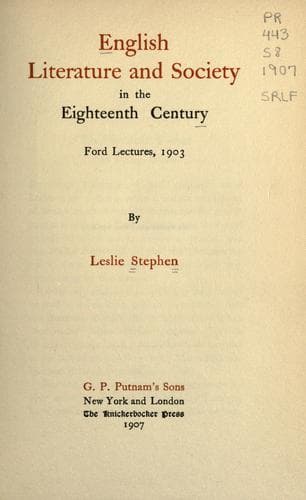
English Literature and Society in the Eighteenth CenturyStephen, Leslie
History
English Literature and Society in the Eighteenth Century
Stephen, Leslie
England -- Social life and customs -- 18th century; English literature -- 18th century -- History and criticism
keeping in contact with fact. We must be 'realistic,' though we can
retain the old literary forms. The appeal to Nature, meanwhile, has come
with Rousseau and the revolutionists to mean something different--the
demand, briefly, for a thorough-going reconstruction of the whole
philosophical and social fabric. To the good old Briton, Whig or Tory,
that seemed to be either diabolical or mere Utopian folly. To him the
British constitution is still thoroughly congenial and 'natural.'
Meanwhile intellectual movement has introduced a new element. The
historical sense is being developed, as a settled society with a complex
organisation becomes conscious at once of its continuity and of the slow
processes of growth by which it has been elaborated. The fusion of
English and Scottish nations stimulates the patriotism of the smaller
though better race, and generates a passionate enthusiasm for the old
literature which represents the characteristic genius of the smaller
community. Burns embodies the sentiment, though without any conscious
reference to theories philosophical or historical. The significance was
to be illustrated by Scott--an equally fervid patriot. He tells Crabbe
how oddly a passage in the _Village_ was associated in his memory with
border-riding ballads and scraps of old plays. 'Nature' for Scott meant
'his honest grey hills' speaking in every fold of old traditional lore.
That meant, in one sense, that Scott was not only romantic but
reactionary. That was his weakness. But if he was the first to make the
past alive, he was also the first to make the present historical. His
masterpieces are not his descriptions of mediaeval knights so much as the
stories in which he illuminates the present by his vivid presentation of
the present order as the outgrowth from the old, and makes the Scottish
peasant or lawyer or laird interesting as a product and a type of social
conditions. Nature therefore to him includes the natural processes by
which society has been developed under the stress of circumstances.
Nothing could be more unnatural for him than the revolutionary principle
which despises tradition and regards the patriotic sentiment as
superfluous and irrational. Wordsworth represents again another sense of
Nature. He announced as his special principle that poetry should speak
the language of Nature, and therefore, as he inferred, of the ordinary
peasant and uneducated man. The hills did not speak to him of legend or
history but of the sentiment of the unsophisticated yeoman or
'statesman.' He sympathised enthusiastically with the French Revolution
so long as he took it to utter the simple republican sentiment congenial
to a small society of farmers and shepherds. He abandoned it when he
came to think that it really meant the dissolution of the religious and
social sentiments which correspond to the deepest instincts which bound
such men together. Coleridge represents a variation. He was the first
Public-domain text, read in full here on John Shaqi.
Reviews
Reviews
No reviews yet
Be the first to share your thoughts on this work.
Elsewhere in the archive
Join the Discussion
Join the discussion
Sign in to leave a comment or review.
Sign InorCreate an account