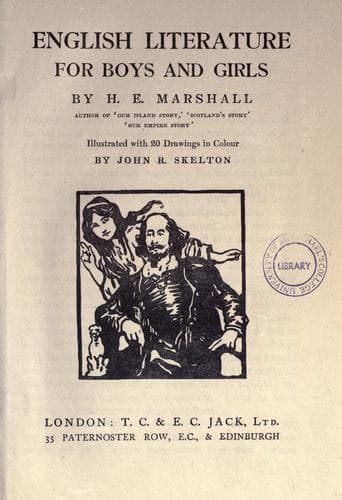
English Literature for Boys and GirlsMarshall, H. E. (Henrietta Elizabeth)
History
English Literature for Boys and Girls
Marshall, H. E. (Henrietta Elizabeth)
English literature -- History and criticism
It was not long ere the King's hiding-place was found, and one of
the traitors leaped down beside him with a great knife in his
hand. "And the King, doubting him for his life, caught him
mightily by the shoulders, and with full great violence cast him
under his feet. For the King was of his person and stature a man
right manly strong."*
*The same.
Seeing this, another traitor leaped down to help his fellow.
"And the King caught him manly by the neck, both under him that
all a long month after men might see how strongly the King had
holden them by the throats."*
*The same.
Fiercely the King struggled with his enemies, trying to wrench
their knives from them so that he might defend himself. But it
was in vain. Seeing him grow weary a third traitor, the King's
greatest enemy, Robert Grahame, leaped down too into the vault,
"with a horrible and mortal weapon in his hand, and therewithal
he smote him through the body, and therewithal the good King fell
down."*
*The same.
And thus the poet King died with sixteen wounds in his brave
heart and many more in his body. So at the long last our story
has a sad ending. But we have to remember that for twelve years
King James had a happy life, and that as he had loved his lady at
the first so he loved her to the end, and was true to her.
Besides The King's Quair, there are a few other short poems which
some people think King James wrote. They are very different from
the Quair, being more like the ballads of the people, and most
people think now that James did not write them. But because they
are different is no real reason for thinking that they are not
his. For James was quite clever enough, we may believe, to write
in more than one way.
Besides these doubtful poems, there is one other poem of three
verses about which no one has any doubt. I will give you one
verse here, for it seems in tune with the King's own life and
sudden death.
"Be not our proud in thy prosperite,
Be not o'er proud in thy prosperity,
For as it cumis, sa will it pass away;
For as it comes, so will it pass away;
Thy tym to compt is short, thou may weille se
Thy time to count is short, thou mayst well see
For of green gres soyn cumis walowit hay,
For of green grass soon cometh withered hay,
Labour is trewth, quhill licht is of the day.
Labour in truth, while light is of the day.
Trust maist in God, for he best gyd thee can,
Trust most in God, for he best guide thee can,
And for ilk inch he wil thee quyt a span."
And for each inch he will thee requite a span.
BOOKS TO READ
An illustration of this chapter may be read in The Fair Maid of
Perth, by Sir Walter Scott; The King's Tragedy (poetry), by D. G.
Rossetti in his Poetical Works. The best version of The King's
Quair in the ancient text is by W. W. Skeat.
Chapter XXX DUNBAR--THE WEDDING OF THE THISTLE AND THE ROSE
Public-domain text, read in full here on John Shaqi.
Reviews
Reviews
No reviews yet
Be the first to share your thoughts on this work.
Elsewhere in the archive
Join the Discussion
Join the discussion
Sign in to leave a comment or review.
Sign InorCreate an account