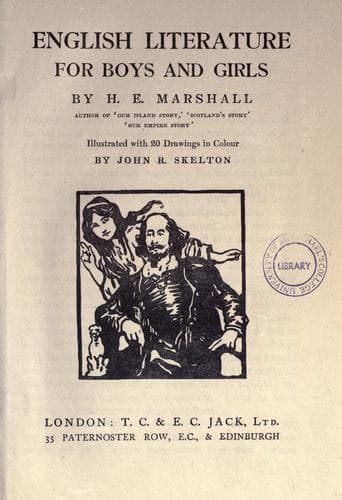
English Literature for Boys and GirlsMarshall, H. E. (Henrietta Elizabeth)
History
English Literature for Boys and Girls
Marshall, H. E. (Henrietta Elizabeth)
English literature -- History and criticism
THE fifteenth century, the century in which King James I reigned
and died, has been called the "Golden Age of Scottish Poetry,"
because of the number of poets who lived and wrote then. And so,
although I am only going to speak of one other Scottish poet at
present, you must remember that there were at this time many
more. But of them all William Dunbar is counted the greatest.
And although I do not think you will care to read his poems for a
very long time to come, I write about him here both because he
was a great poet and because with one of his poems, The Thistle
and the Rose, he takes us back, as it were, over the Border into
England once more.
William Dunbar was perhaps born in 1460 and began his life when
James III began his reign. He was of noble family, but there is
little to know about his life, and as with Chaucer, what we learn
about the man himself we learn chiefly from his writing. We
know, however, that he went to the University of St. Andrews, and
that it was intended that he should go into the Church. In those
days in Scotland there were only two things a gentleman might be
- either he must be a soldier or a priest. Dunbar's friends,
perhaps seeing that he was fond of books, thought it best to make
him a priest. But indeed he had made a better soldier. For a
time, however, although he was quite unsuited for such a life, he
became a friar. As a preaching friar he wandered far.
"For in every town and place
Of all England from Berwick to Calais,
I have in my habit made good cheer.
In friar's weed full fairly have I fleichet,*
In it have I in pulpit gone and preached,
In Dernton kirk and eke in Canterbury,
In it I passed at Dover o'er the ferry
Through Picardy, and there the people teached."
*Flattered.
Dunbar himself knew that he had no calling to be a friar or
preacher. He confesses that
"As long as I did bear the friar's style
In me, God wot, was many wrink and wile,
In me was falseness every wight to flatter,
Which might be banished by no holy water;
I was aye ready all men to beguile."
Public-domain text, read in full here on John Shaqi.
Reviews
Reviews
No reviews yet
Be the first to share your thoughts on this work.
Elsewhere in the archive
Join the Discussion
Join the discussion
Sign in to leave a comment or review.
Sign InorCreate an account