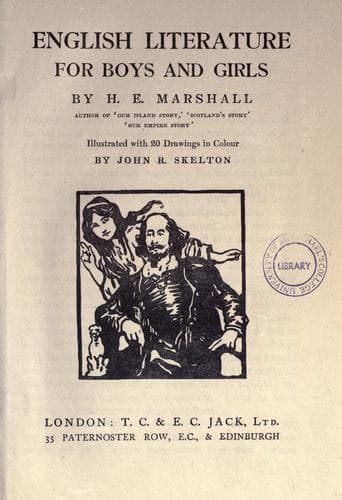
English Literature for Boys and GirlsMarshall, H. E. (Henrietta Elizabeth)
History
English Literature for Boys and Girls
Marshall, H. E. (Henrietta Elizabeth)
English literature -- History and criticism
Books began to grow many and cheap. More and more people learned
to read, and this helped to settle our language into a form that
was to last. French still, although it was no longer the
language of the court or of the people, had an influence on our
speech. People traveled little, and in different parts of the
country different dialects, which were almost like different
languages, were spoken. We have seen that the "Inglis" of
Scotland differed from Chaucer's English, and the language of the
north of England differed from it just as much. But when printed
books increased in number quickly, when every man could see for
himself what the printed words looked like, these differences
began to die out. Then our English, as a literary language, was
born.
It was Caxton, you remember, who was the first English printer.
We have already heard of him when following the Arthur story as
the printer of Malory's Morte d'Arthur. But Caxton was not only
a printer, he was author, editor, printer, publisher and
bookseller all in one.
William Caxton, as he himself tells us, was born in Kent in the
Weald. But exactly where or when we do not know, although it may
have been about the year 1420. Neither do we know who or what
his father was. Some people think that he may have been a mercer
or cloth merchant, because later Caxton was apprenticed to one of
the richest cloth merchants of London. In those days no man was
allowed to begin business for himself until he had served for a
number of years as an apprentice. When he had served his time,
and then only, was he admitted into the company and allowed to
trade for himself. As the Mercers' Company was one of the
wealthiest and most powerful of the merchant companies, they were
very careful of whom they admitted as apprentices. Therefore it
would seem that really Caxton's family was "of great repute of
old, and genteel-like," as an old manuscript says.*
*Harleian MS., 5910.
Caxton's master died before he had finished his apprenticeship,
so he had to find a new master, and very soon he left England and
went to Bruges. There he remained for thirty-five years.
In those days there was much trade between England and Flanders
(Belgium we now call the country) in wool and cloth, and there
was a little colony of English merchants in Bruges. There Caxton
steadily rose in importance until he became "Governor of the
English Nation beyond the seas." As Governor he had great power,
and ruled over his merchant adventurers as if he had been a king.
But even with all his other work, with his trading and ruling to
attend to, Caxton found time to read and write, and he began to
translate from the French a book of stories called the Recuyell*
of the Histories of Troy. This is a book full of the stories of
Greek heroes and of the ancient town of Troy.
*Collection, from the French word recueillir, to gather.
Public-domain text, read in full here on John Shaqi.
Reviews
Reviews
No reviews yet
Be the first to share your thoughts on this work.
Elsewhere in the archive
Join the Discussion
Join the discussion
Sign in to leave a comment or review.
Sign InorCreate an account