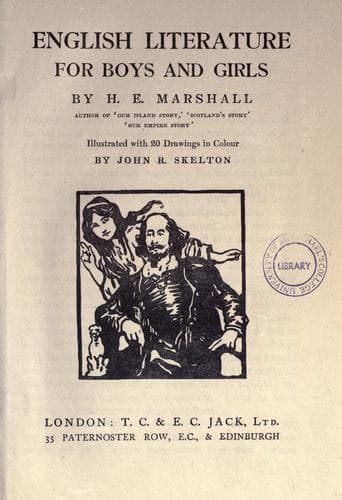
English Literature for Boys and GirlsMarshall, H. E. (Henrietta Elizabeth)
History
English Literature for Boys and Girls
Marshall, H. E. (Henrietta Elizabeth)
English literature -- History and criticism
Thus did Dunbar sing of the wedding of the Thistle and the Rose.
It was a marriage by which the two peoples hoped once more to
bring a lasting peace between the two countries. And although
the hope was not at once fulfilled, it was a hundred years later.
For upon the death of Elizabeth, James VI of Scotland, the great-
grandson of Margaret Tudor and James Stuart, received the crown
of England also, thus joining the two rival countries. Then came
the true marriage of the Thistle and the Rose.
Meanwhile, as long as Henry VII remained upon the throne, there
was peace between the two peoples. But when Henry VIII began to
rule, his brother-in-law of Scotland soon found cause to quarrel
with him. Then once again the Thistle and the Rose met, not in
peace, but in war. On the red field of Flodden once again the
blood of a Scottish King stained the grass. Once again Scotland
was plunged in tears.
After "that most dolent day"* we hear no more of Dunbar. It is
thought by some that he, as many another knight, courtier and
priest, laid down his life fighting for his King, and that he
fell on Flodden field. By others it is thought that he lived to
return to Scotland, and that the Queen gave to him one of the now
many vacant Church livings, and that there he spent his last days
in quietness and peace.
*Sir David Lyndsay.
This may have been so. For although Dunbar makes no mention of
Flodden in his poems, it is possible that he may have done so in
some that are lost. But where this great poet lies taking his
last rest we do not know. It may be he was laid in some quiet
country churchyard. It may be he met death suddenly amid the din
and horror of battle.
BOOKS TO READ
In illustration of this chapter may be read "Edinburgh after
Flodden" in Lays of the Scottish Cavaliers, by W. E. Aytoun. The
best edition of the Poems of Dunbar in the original is edited by
J. Small.
Chapter XXXI AT THE SIGN OF THE RED PALE
IF the fifteenth century has been called the Golden Age of
Scottish poetry, it was also the dullest age in English
literature. During the fifteenth century few books were written
in England. One reason for this was that in England it was a
time of foreign and of civil war. The century opened in war with
Wales, it continued in war with France. Then for thirty years
the wars of the Roses laid desolate the land. They ended at
length in 1485 with Bosworth field, by which Henry VII became
King.
But in spite of all the wars and strife, the making of books did
not quite cease. And if only a few books were written, it was
because it was a time of rebirth and new life as well as a time
of war and death. For it was in the fifteenth century that
printing was discovered. Then it was that the listening time was
really done. Men began to use their eyes rather than their ears.
They saw as they had never before seen.
Public-domain text, read in full here on John Shaqi.
Reviews
Reviews
No reviews yet
Be the first to share your thoughts on this work.
Elsewhere in the archive
Join the Discussion
Join the discussion
Sign in to leave a comment or review.
Sign InorCreate an account