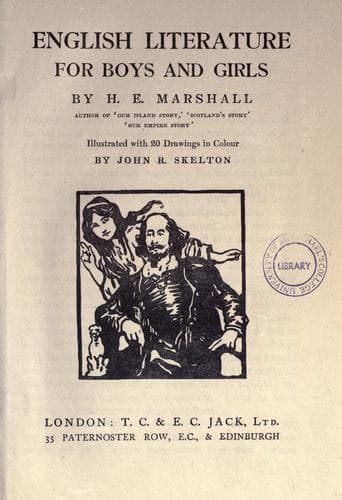
English Literature for Boys and GirlsMarshall, H. E. (Henrietta Elizabeth)
History
English Literature for Boys and Girls
Marshall, H. E. (Henrietta Elizabeth)
English literature -- History and criticism
*Another word for sayings, from the French dire, to say.
To the people of Caxton's day printing seemed a marvelous thing.
So marvelous did it seem that some of them thought it could only
be done by the help of evil spirits. It is strange to think that
in those days, when anything new and wonderful was discovered,
people at once thought that it must be the work of evil spirits.
That it might be the work of good spirits never seemed to occur
to them.
Printing, indeed, was a wonderful thing. For now, instead of
taking weeks and months to make one copy of a book, a man could
make dozens or even hundreds at once. And this made books so
cheap that many more people could buy them, and so people were
encouraged both to read and write. Instead of gathering together
to hear one man read out of a book, each man could buy a copy for
himself. At the end of one of his books Caxton begs folk to
notice "that it is not written with pen and ink as other books
be, to the end that every man may have them at once. For all the
books of this story, called the Recuyell of the Histories of Troy
thus imprinted as ye see here were begun on one day and also
finished in one day." We who live in a world of books can hardly
grasp what that meant to the people of Caxton's time.
For fourteen years Caxton lived a busy life, translating,
editing, and printing. Besides that he must have led a busy
social life, for he was a favorite with Edward IV, and with his
successors Richard III and Henry VII too. Great nobles visited
his workshop, sent him gifts, and eagerly bought and read his
books. The wealthy merchants, his old companions in trade, were
glad still to claim him as a friend. Great ladies courted,
flattered, and encouraged him. He married, too, and had
children, though we known nothing of his home life. Altogether
his days were full and busy, and we may believe that he was
happy.
But at length Caxton's useful, busy life came to an end. On the
last day of it he was still translating a book from French. He
finished it only a few hours before he died. We know this,
although we do not know the exact date of his death. For his
pupil and follower, who carried on his work afterwards, says on
the title-page of this book that it was "finished at the last day
of his life."
Caxton was buried in the church near which he had worked--St.
Margaret's, Westminster. He was laid to rest with some ceremony
as a man of importance, for in the account-books of the parish we
find these entries:--
"At burying of William Caxton for four torches 6s. 8d.
For the bell at same burying 6d."
This was much more than was usually spent at the burial of
ordinary people in those days.
Among the many books which Caxton printed we must not forget Sir
Thomas Malory's Morte d'Arthur, which we spoke of out of its
place in following the story of Arthur in Chapter VIII. Perhaps
you would like to turn back and read it over again now.
Public-domain text, read in full here on John Shaqi.
Reviews
Reviews
No reviews yet
Be the first to share your thoughts on this work.
Elsewhere in the archive
Join the Discussion
Join the discussion
Sign in to leave a comment or review.
Sign InorCreate an account