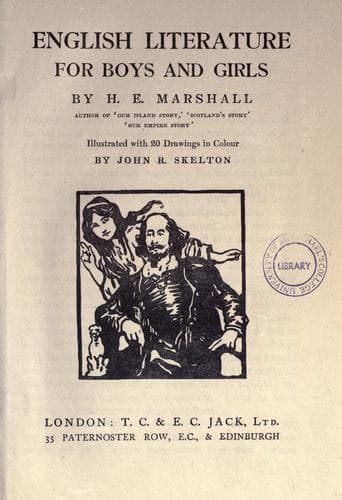
English Literature for Boys and GirlsMarshall, H. E. (Henrietta Elizabeth)
History
English Literature for Boys and Girls
Marshall, H. E. (Henrietta Elizabeth)
English literature -- History and criticism
As we have said, Caxton was not merely a printer. He was an
author too. But although he translated books both from French
and Dutch, it is perhaps to his delightful prefaces more than to
anything else that he owes his title of author. Yet it must be
owned that sometimes they are not all quite his own, but parts
are taken wholesale from other men's works or are translated from
the French. We are apt to look upon a preface as something dull
which may be left unread. But when you come to read Caxton's
books, you may perhaps like his prefaces as much as anything else
about them. In one he tells of his difficulties about the
language, because different people spoke it so differently. He
tells how once he began to translate a book, but "when I saw the
fair and strange terms therein, I doubted that it should not
please some gentlemen which late blamed me, saying that in my
translation I had over curious terms, which could not be
understood by common people, and desired me to use old and homely
terms in my translations. And fain would I satisfy every man.
And so to do I took an old book and read therein, and certainly
the English was so rude and broad that I could not well
understand it. . . . And certainly our language now used varieth
far from that which was used and spoken when I was born. . . .
And that common English that is spoken in one shire varyeth from
another. In-so-much that in my days it happened that certain
merchants were in a ship in Thames, for to have sailed over the
sea into Zealand. For lack of wind they tarried at Foreland, and
went to land for to refresh them.
"And one of them, named Sheffield, a mercer, came into a house
and asked for meat. And especially he asked for eggs. And the
good wife answered that she could speak no French. And the
merchant was angry, for he also could speak no French, but would
have had eggs, and she understood him not.
"And then at last another said that he would have eyren. Then
the good wife said that she understood him well. So what should
a man in these days now write, eggs or eyren? Certainly it is
hard to please every man by cause of diversity and change of
language. . . .
"And some honest and great clerks have been with me, and desired
me to write the most curious terms that I could find. And thus
between plain, rude, and curious I stand abashed. But in my
judgement the common terms that be daily used, be lighter to be
understood than the old and ancient English."
In another book Caxton tells us that he knows his own "simpleness
and unperfectness" in both French and English. "For in France
was I never, and was born and learned my English in Kent, in the
Weald, where I doubt not is spoken as broad and rude English as
in any place in England."
So you see our English was by no means yet settled. But
printing, perhaps, did more than anything else to settle it.
Public-domain text, read in full here on John Shaqi.
Reviews
Reviews
No reviews yet
Be the first to share your thoughts on this work.
Elsewhere in the archive
Join the Discussion
Join the discussion
Sign in to leave a comment or review.
Sign InorCreate an account