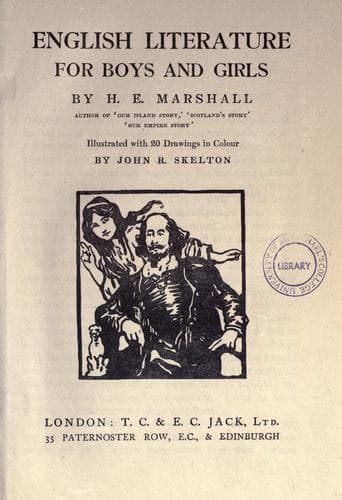
English Literature for Boys and GirlsMarshall, H. E. (Henrietta Elizabeth)
History
English Literature for Boys and Girls
Marshall, H. E. (Henrietta Elizabeth)
English literature -- History and criticism
The demons were generally funny, and Noah's wife, who argued
about going into the ark. The shepherds, also, watching their
flocks by night, were almost sure to make the people laugh.
But there were solemn moments, too, when the people reverently
listened to the grave words of God the Father, or to those,
tender and loving, of Mary, the Virgin Mother. And when the
shepherds neared the manger where lay the wondrous Babe, all
jesting ceased. Here there was nothing but tender, if simple and
unlearned, adoration.
In those early days Latin was the tongue of the Church, and the
Miracle plays were at first said in Latin. But as the common
folk could not understand what was said, the plays were chiefly
shown in dumb show. Soon, however, Latin was given up, and the
plays were acted in English. Then by degrees the churches grew
too small to hold the great crowds of people who wished to see
the plays, and so they were acted outside the church door in the
churchyard, on a stage built level with the steps. The church,
then, could be made to represent heaven, where God and the angels
dwelt. The stage itself was the world, and below it was hell,
from out of which came smoke and sometimes flames, and whence
might be heard groans and cries and the clanking of chains.
But the playing of Mysteries and Miracles at the church doors had
soon to be given up. For the people, in their excitement, forgot
the respect due to the dead. They trampled upon the graves and
destroyed the tombs in their eagerness to see. And when the play
was over the graveyard was a sorry sight with trodden grass and
broken headstones. So by degrees it came about that these plays
lost their connection with the churches, and were no more played
in or near them. They were, instead, played in some open space
about the town, such as the market-place. Then, too, the players
ceased to be monks and priests, and the acting was taken up by
the people themselves. It was then that the playing came into
the hands of the trade guilds.
Nowadays we hear a great deal about "trades unions." But in
those far-off days such things were unknown. Each trade,
however, had its own guild by which the members of it were bound
together. Each guild had its patron saint, and after a time the
members of a guild began to act a play on their saint's day in
his honor. Later still the guilds all worked together, and all
acted their plays on one day. This was Corpus Christi Day, a
feast founded by Pope Urban IV in 1264. As this feast was in
summer, it was a very good time to act the plays, for the weather
was warm and the days were long. The plays often began very
early in the morning as soon as it was light, and lasted all day.
Public-domain text, read in full here on John Shaqi.
Reviews
Reviews
No reviews yet
Be the first to share your thoughts on this work.
Elsewhere in the archive
Join the Discussion
Join the discussion
Sign in to leave a comment or review.
Sign InorCreate an account