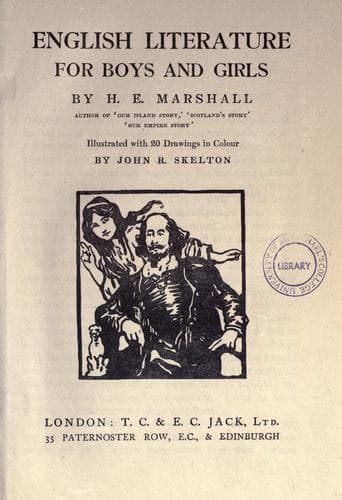
English Literature for Boys and GirlsMarshall, H. E. (Henrietta Elizabeth)
History
English Literature for Boys and Girls
Marshall, H. E. (Henrietta Elizabeth)
English literature -- History and criticism
If we would picture to ourselves what these first English plays
were like, we must not think of a brilliantly lighted theater
pranked out and fine with red and gold and white such as we know.
We must think rather of some dim old church. Stately pillars
rise around us, and the outline of the arches is lost in the high
twilight of the roof. Behind the quaintly dressed players gleams
the great crucifix with its strange, sad figure and outstretched
arms which, under the flickering light of the high altar candles,
seems to stir to life. And beyond the circle of light, in the
soft darkness of the nave, the silent people kneel or stand to
watch.
It was in such solemn surroundings that our first plays were
played. And the stories that were acted were Bible stories.
There was no thought of irreverence in such acting. On the
contrary, these plays were performed "to exort the mindes of
common people to good devotion and holesome doctrine."
You remember when Caedmon sang, he made his songs of the stories
of Genesis and Exodus. And in this way, in those bookless days,
the people were taught the Bible stories. But you know that what
we learn by our ears is much harder to remember than what we
learn by our eyes. If we are only told a thing we may easily
forget it. But if we have seen it, or seen a picture of it, we
remember it much more easily. In those far-off days, however,
there were as few pictures as there were books in England. And
so the priests and monks fell upon the plan of acting the Bible
stories and the stories of the saints, so that the people might
see and better understand.
These plays which the monks made were called Mystery or Miracle
plays. I cannot tell you the exact date of our first Miracle
plays, but the earliest that we know of certainly was acted at
the end of the eleventh or beginning of the twelfth century. It
is not unreasonable to suppose, however, that there had been
still earlier plays of which we know nothing. For the Miracle
plays did not spring all at once to life, they began gradually,
and the beginnings can be traced as far back as the ninth
century. In an old book of rules for Winchester Cathedral,
written about 959, there are directions given for showing the
death and resurrection of Christ in dumb show chiefly, with just
a few Latin sentences to explain it. By degrees these plays grew
longer and fuller, until in them the whole story of man from the
Creation to the Day of Judgment was acted in what was called a
cycle or circle of short acts or plays.
But although these plays were looked upon as an act of religion,
they were not all solemn. At times, above the grave tones of the
monks or the solemn chanting of the choir, laughter rang out.
For some of the characters were meant to be funny, and the
watching crowd knew and greeted them as such even before they
spoke, just as we know and greet the jester or the clown.
Public-domain text, read in full here on John Shaqi.
Reviews
Reviews
No reviews yet
Be the first to share your thoughts on this work.
Elsewhere in the archive
Join the Discussion
Join the discussion
Sign in to leave a comment or review.
Sign InorCreate an account