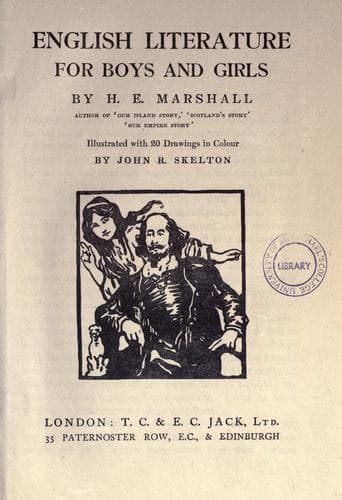
English Literature for Boys and GirlsMarshall, H. E. (Henrietta Elizabeth)
History
English Literature for Boys and Girls
Marshall, H. E. (Henrietta Elizabeth)
English literature -- History and criticism
Meanwhile, Gill from her bed cries out at them, calling them
thieves. "Ye come to rob us. I swear if ever I you beguiled,
that I eat this child that lies in this cradle."
The shepherds at length begin to be sorry that they have been so
unjust as to suspect Mak. They wish to make friends again. But
Mak will not be friends. "Farewell, all three, and glad I am to
see you go," he cries.
So the shepherds go a little sadly. "Fair winds may there be,
but love there is none this year," says one.
"Gave ye the child anything?" says another.
"I trow not a farthing."
"Then back will I go," says the third shepherd, "abide ye there."
And back he goes full of his kindly thought. "Mak," he says,
"with your leave let me give your bairn but sixpence."
But Mak still pretends to be sulky, and will not let him come
near the child. By this time all the shepherds have come back.
One wants to kiss the baby, and bends over the cradle. Suddenly
he starts back. What a nose! The deceit is found out and the
shepherds are very angry. Yet even in their anger they can
hardly help laughing. Mak and Gill, however, are ready of wit.
They will not own to the theft. It is a changeling child, they
say.
"He was taken with an elf,
I saw it myself,
When the clock struck twelve was he foreshapen,"
says Gill.
But the shepherds will not be deceived a second time. They
resolve to punish Mak, but let him off after having tossed him in
a blanket until they are tired and he is sore and sorry for
himself.
This sheepstealing scene shows how those who wrote the play tried
to catch the interest of the people. For every one who saw this
scene could understand it. Sheepstealing was a very common crime
in England in those days, and was often punished by death.
Probably every one who saw the play knew of such cases, and the
writers used this scene as a link between the everyday life,
which was near at hand and easy to understand, and the story of
the birth of Christ, which was so far off and hard to understand.
And it is now, when the shepherds are resting from their hard
work of beating Mak, that they hear the angels sing "Glory to God
in the highest." From this point on all the jesting ceases, and
in its rough way the play is reverent and loving.
The angel speaks.
"Rise, herdmen, quickly, for now is he born
That shall take from the fiend what Adam was lorn;
That demon to spoil this night is he born,
God is made your friend now at this morn.
He behests
At Bethlehem go see,
There lies that fre*
In a crib full poorly
Betwixt two beasties."
*Noble.
Public-domain text, read in full here on John Shaqi.
Reviews
Reviews
No reviews yet
Be the first to share your thoughts on this work.
Elsewhere in the archive
Join the Discussion
Join the discussion
Sign in to leave a comment or review.
Sign InorCreate an account