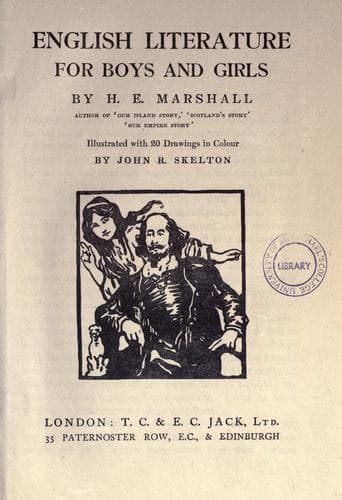
English Literature for Boys and GirlsMarshall, H. E. (Henrietta Elizabeth)
History
English Literature for Boys and Girls
Marshall, H. E. (Henrietta Elizabeth)
English literature -- History and criticism
The shepherds hear the words of the angel, and looking upward see
the guiding star. Wondering at the music, talking of the
prophecies of David and Isaiah, they hasten to Bethlehem and find
the lowly stable. Here, with a mixture of awe and tenderness,
the shepherds greet the Holy Child. It is half as if they spoke
to the God they feared, half as if they played with some little
helpless baby who was their very own. They mingle simple things
of everyday life with their awe. They give him gifts, but their
simple minds can imagine no other than those they might give to
their own children.
The first shepherd greets the child with words:--
"Hail, comely and clean! Hail, young child!
Hail, maker as methinks of a maiden so mild.
Thou hast warred, I ween, the demon so wild."
Then he gives as his gift a bob of cherries.
The second shepherd speaks:--
"Hail! sovereign saviour! for thee have we sought.
Hail, noble child and flower that all thing hast wrought.
Hail, full of favour, that made all of nought.
Hail! I kneel and I cower! A bird have I brought
To my bairn.
Hail, little tiny mop,
Of our creed thou art crop,*
I would drink to thy health,
Little Day Star!"
*Head.
The third shepherd speaks:--
Hail! darling dear full of Godhead!
I pray thee be near when that I have need!
Hail! sweet is thy cheer! My heart would bleed
To see thee sit here in so poor weed
With no pennies.
Hail! put forth thy dall.*
I bring thee but a ball:
Have and play thee with all
And go to the tennis."
*Hand.
And so the pageant of the shepherds comes to an end, and they
return home rejoicing.
This play gives us a good idea of how the Miracles wound
themselves about the lives of the people. It gives us a good
idea of the rudeness of the times when such jesting with what we
hold as sacred seemed not amiss. It gives, too, the first gleam
of what we might call true comedy in English.
Chapter XXXIV THE STORY OF EVERYMAN
A LITTLE later than the Miracle and Mystery plays came another
sort of play called the Moralities. In these, instead or
representing real people, the actors represented thoughts,
feelings and deeds, good and bad. Truth, for instance, would be
shown as a beautiful lady; Lying as an ugly old man, and so on.
These plays were meant to teach just as the Miracles were meant
to teach. But instead of teaching the Bible stories, they were
made to show men the ugliness of sin and the beauty of goodness.
When we go to the theater now we only think of being amused, and
it is strange to remember that all acting was at first meant to
teach.
Public-domain text, read in full here on John Shaqi.
Reviews
Reviews
No reviews yet
Be the first to share your thoughts on this work.
Elsewhere in the archive
Join the Discussion
Join the discussion
Sign in to leave a comment or review.
Sign InorCreate an account