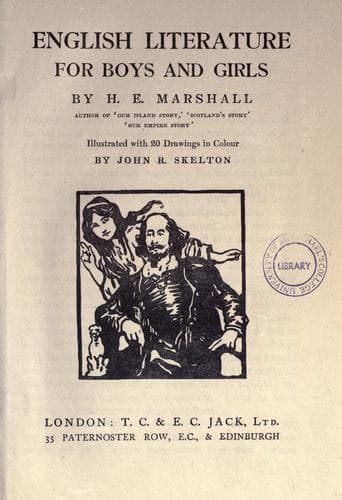
English Literature for Boys and GirlsMarshall, H. E. (Henrietta Elizabeth)
History
English Literature for Boys and Girls
Marshall, H. E. (Henrietta Elizabeth)
English literature -- History and criticism
"For although my rhyme is ragged,
Tattered and jagged,
Rudely rain-beaten,
Rust and moth eaten,
If ye take well therewith,
It hath in it some pith."
And it is well to remember the name of Colin Cloute at least,
because a later and much greater poet borrowed that name for one
of his own poems, as you shall hear.
But the poem which keeps most interest for us is one which
perhaps at the time it was written was thought least important.
It is called The Book of Philip Sparrow. And this poem shows us
that Skelton was not always bitter and biting. For it is neither
bitter nor coarse, but is a dainty and tender lament written for
a schoolgirl whose sparrow had been killed by a cat. It is
written in the same short lines as Colin Cloute and others of
Skelton's poems--"Breathless rhymes"* they have been called.
These short lines remind us somewhat of the old Anglo-Saxon short
half-lines, except that they rime. They are called after their
author "Skeltonical."
*Bishop Hall.
What chiefly makes The Book of Philip Sparrow interesting is that
it is the original of our nursery rime Who Killed Cock Robin? It
is written in the form of a dirge, and many people were shocked
at that, for they said that it was but another form of mockery
that this jesting priest had chosen with which to divert himself.
But I think that little Jane Scoupe at school in the nunnery at
Carowe would dry her eyes and smile when she read it. She must
have been pleased that the famous poet, who had been the King's
tutor and friend and who had been both the friend and enemy of
the great Cardinal, should trouble to write such a long poem all
about her sparrow.
Here are a few quotations from it:--
"Pla ce bo,*
Who is there who?
Di le sci,
Dame Margery;
Fa re my my,
Wherefore and why why?
For the soul of Philip Sparrow
That was late slain at Carowe
Among the nuns black,
For that sweet soul's sake,
And for all sparrows' souls,
Set in our bead rolls,
Pater Noster qui,
With an Ave Mari,
And with the corner of a creed,
The more shall be your need.
Public-domain text, read in full here on John Shaqi.
Reviews
Reviews
No reviews yet
Be the first to share your thoughts on this work.
Elsewhere in the archive
Join the Discussion
Join the discussion
Sign in to leave a comment or review.
Sign InorCreate an account