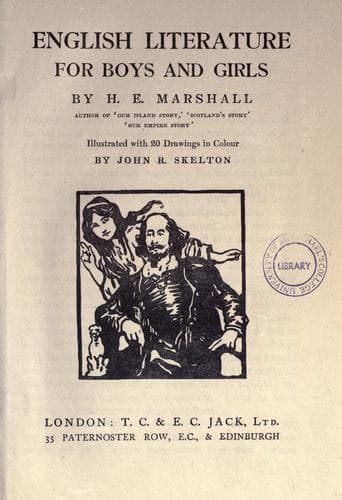
English Literature for Boys and GirlsMarshall, H. E. (Henrietta Elizabeth)
History
English Literature for Boys and Girls
Marshall, H. E. (Henrietta Elizabeth)
English literature -- History and criticism
The Reformation had begun. The teaching of Piers Ploughman, the
preaching of Wyclif, had long since almost been forgotten, but it
had never altogether died out. The evils in the Church and in
high places were as bad as ever, and Skelton, himself a priest,
preached against them. He attacked other, even though he himself
sinned against the laws of priesthood. For he was married, and
in those days marriage was forbidden to clergymen, and his life
was not so fair as it might have been.
At first Wolsey, the great Cardinal and friend of Henry VIII, was
Skelton's friend too. But Skelton's tongue was mocking and
bitter. "He was a sharp satirist, but with more railing and
scoffery than became a poet-laureate,"* said one. The Cardinal
became an enemy, and the railing tongue was turned against him.
In a poem called Colin Cloute Skelton pointed out the evils of
his day and at the same time pointed the finger of scorn at
Wolsey. Colin Cloute, like Piers Ploughman, was meant to mean
the simple good Englishman.
*George Puttenham.
"Thus I Colin Cloute,
As I go about,
And wandering as I walk,
There the people talk.
Men say, for silver and gold
Mitres are bought and sold."
And again:--
"Laymen say indeed,
How they (the priests) take no heed
Their silly sheep to feed,
But pluck away and pull
The fleeces of their wool."
But he adds:--
"Of no good bishop speak I,
Nor good priest I decry,
Good friar, nor good chanon,*
Good nun, nor good canon,
Good monk, nor good clerk,
Nor yet no good work:
But my recounting is
Of them that do amiss."
*Same as canon.
Yet, although Skelton said he would not decry any good man or any
good work, his spirit was a mocking one. He was fond of harsh
jests and rude laughter, and no person or thing was too high or
too holy to escape his sharp wit. "He was doubtless a pleasant
conceited fellow, and of a very sharp wit," says a writer about
sixty years later, "exceeding bold, and would nip to the very
quick when he once set hold."*
*William Webbe.
And being bold as bitter, and having set hold with hatred upon
Wolsey, he in another poem called Why come ye not to Court? and
in still another called Speake, Parrot, wrote directly against
the Cardinal. Yet although Skelton railed against the Cardinal
and against the evils in the Church, he was no Protestant. He
believed in the Church of Rome, and would have been sorry to
think that he had helped the "heretics."
Wolsey was still powerful, and he made up his mind to silence his
enemy, so Skelton found himself more than once in prison, and at
last to escape the Cardinal's anger he was forced to take
sanctuary in Westminster. There he remained until he died a few
months before his great enemy fell from power.
As many of Skelton's poems were thus about quarrels over religion
and politics, much of the interest in them has died. Yet, as he
himself says,
Public-domain text, read in full here on John Shaqi.
Reviews
Reviews
No reviews yet
Be the first to share your thoughts on this work.
Elsewhere in the archive
Join the Discussion
Join the discussion
Sign in to leave a comment or review.
Sign InorCreate an account