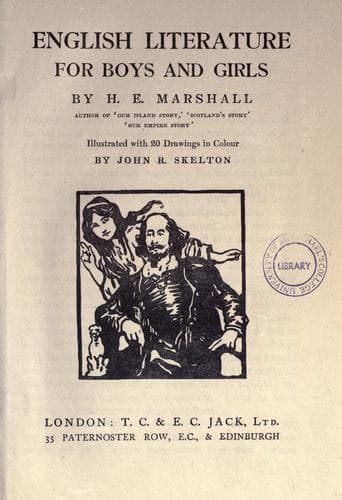
English Literature for Boys and GirlsMarshall, H. E. (Henrietta Elizabeth)
History
English Literature for Boys and Girls
Marshall, H. E. (Henrietta Elizabeth)
English literature -- History and criticism
*Tore to pieces.
. . . .
These villainous false cats,
Were made for mice and rats,
And not for birdies small.
. . . .
Alas, mine heart is slayeth
My Philip's doleful death,
When I remember it,
How prettily it would sit,
Many times and oft,
Upon my finger aloft.
. . . .
To weep with me, look that ye come,
All manner of birds of your kind;
So none be left behind,
To mourning look that ye fall
With dolorous songs funeral,
Some to sing, and some to say,
Some to weep, and some to pray,
Every bird in his lay.
The goldfinch and the wagtail;
The gangling jay to rail,
The flecked pie to chatter
Of the dolorous matter;
The robin redbreast,
He shall be the priest,
The requiem mass to sing,
Softly warbling,
With help of the red sparrow,
And the chattering swallow,
This hearse for to hallow;
The lark with his lung too,
The chaffinch and the martinet also;
. . . .
The lusty chanting nightingale,
The popinjay to tell her tale,
That peepeth oft in the glass,
Shall read the Gospel at mass;
The mavis with her whistle
Shall read there the Epistle,
But with a large and a long
To keep just plain song.
. . . .
The peacock so proud,
Because his voice is loud,
And hath a glorious tail
He shall sing the grayle;*
The owl that is so foul
Must help us to howl.
*Gradual = the part of the mass between Epistle and Gospel.
. . . .
At the Placebo
We may not forgo
The chanting of the daw
The stork also,
That maketh her nest
In chimnies to rest.
. . . .
The ostrich that will eat
A horseshoe so great,
In the stead of meat,
Such fervent heat
His stomach doth gnaw.
He cannot well fly
Nor sing tunably.
. . . .
The best that we can
To make him our bellman,
And let him ring the bells,
He can do nothing else.
Chanticlere our cock
Must tell what is of the clock
By the astrology
That he hath naturally
Conceived and caught,
And was never taught.
. . . .
To Jupiter I call
Of heaven imperial
That Philip may fly
Above the starry sky
To greet the pretty wren
That is our Lady's hen,
Amen, amen, amen.
Chapter XXXVI THE RENAISSANCE
RENAISSANCE means rebirth, and to make you understand something
of what the word means in our literature I must take you a long
way. You have been told that the fifteenth century was a dull
time in English literature, but that it was also a time of new
action and new life, for the discovery of new worlds and the
discovery of printing had opened men's eyes and minds to new
wonders. There was a third event which added to this new life by
bringing new thought and new learning to England. That was the
taking of Constantinople by the Turks.
Public-domain text, read in full here on John Shaqi.
Reviews
Reviews
No reviews yet
Be the first to share your thoughts on this work.
Elsewhere in the archive
Join the Discussion
Join the discussion
Sign in to leave a comment or review.
Sign InorCreate an account