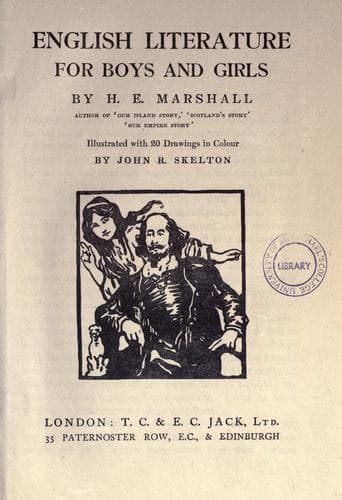
English Literature for Boys and GirlsMarshall, H. E. (Henrietta Elizabeth)
History
English Literature for Boys and Girls
Marshall, H. E. (Henrietta Elizabeth)
English literature -- History and criticism
It seems difficult to understand how the taking of Constantinople
could have any effect on our literature. I will try to explain,
but in order to do so clearly I must go back to the time of the
Romans.
All of you have read English history, and there you read of the
Romans. You know what a clever and conquering people they were,
and how they subdued all the wild tribes who lived in the
countries around them. Besides conquering all the barbarians
around them, the Romans conquered another people who were not
barbarians, but who were in some ways more civilized than
themselves. These were the Greeks. They had a great literature,
they were more learned and quite as skilled in the arts of peace
as the Romans. Yet in 146 B.C., long before the Romans came to
our little island, Greece became a Roman province.
Nearly five hundred years later there sat upon the throne an
Emperor named Constantine. And he, although Rome was still
pagan, became a Christian. He was, besides, a great and powerful
ruler. His court was brilliant, glittering with all the golden
splendor of those far-off times. But although Rome was still
pagan, Greece, a Roman province, had become Christian. And in
this Christian province Constantine made up his mind to build a
New Rome.
In those days the boundaries of Greece stretched far further than
they do now, and it was upon the shores of the Bosphorus that
Constantine built his new capital. There was already an ancient
town there named Byzantium, but he transformed it into a new and
splendid city. The Emperor willed it to be called New Rome, but
instead the people called it the city of Constantine, and we know
it now as Constantinople.
When Constantinople was founded it was a Roman city. All the
rulers were Roman, all the high posts were filled by Romans, and
Latin was the speech of the people. But in Constantinople it
happened as it had happened in England after the Conquest. In
England, for a time after the Conquest, the rulers were French
and the language was French, but gradually all that passed away,
and the language and the rulers became English once more. So it
was in Constantinople. By degrees it became a Greek city, the
rulers became Greek, and Greek was the language spoken.
In building a second capital Constantine had weakened his Empire.
Soon it was split in two, and there arose a western and an
eastern Empire. As time went on the Western Empire with Rome at
its head declined and fell, while the Eastern Empire with
Constantinople as its capital grew great. But it grew into a
Greek Empire. Even very clever people cannot tell the exact date
at which the Roman Empire came to an end and the Greek or
Byzantine Empire, as it is called, began. So we need not trouble
about that. All that is needful for us to understand now it that
Constantinople was a Christian city, a Greek city, and a
treasure-house of Greek learning and literature.
Public-domain text, read in full here on John Shaqi.
Reviews
Reviews
No reviews yet
Be the first to share your thoughts on this work.
Elsewhere in the archive
Join the Discussion
Join the discussion
Sign in to leave a comment or review.
Sign InorCreate an account