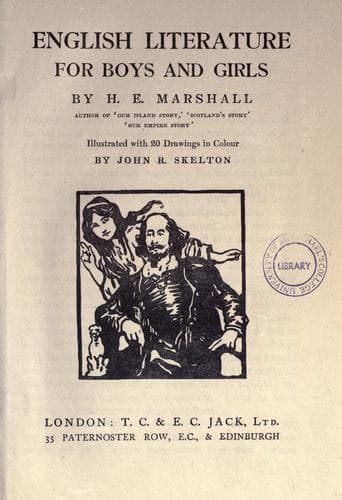
English Literature for Boys and GirlsMarshall, H. E. (Henrietta Elizabeth)
History
English Literature for Boys and Girls
Marshall, H. E. (Henrietta Elizabeth)
English literature -- History and criticism
But More knew that it would be a hard matter to make things
better in England. As he makes Hythlodaye say, it is no use
trying to improve things in a blundering fashion. It is of no
use trying by fear to drive into people's heads things they have
no mind to learn. Neither must you "forsake the ship in a
tempest, because you cannot rule and keep down the winds." But
"you must with a crafty wile and subtile train, study and
endeavour yourself, as much as in you lieth, to handle the matter
wittily and handsomely for the purpose. And that which you
cannot turn to good, so to order it that it be not very bad. For
it is not possible for all things to be well, unless all men were
good: which I think will not be yet in these good many years."
The Utopia is divided into two books. The first and shorter
gives us what we might call the machinery of the tale. It tells
of the meeting with Hythlodaye and More's first talk with him.
It is not until the beginning of the second book that we really
hear about Utopia. And I think if you read the book soon, I
would advise you to begin with the second part, which More wrote
first. In the second book we have most of the story, but the
first book helps us to understand More's own times and explains
what he was trying to do in writing his tale.
At the beginning of this book I told you that we should have to
talk of many books which for the present, at least, you could not
hope to like, but which you must be content to be told are good
and worth reading. I may be wrong, but I think Utopia is one of
these. Yet as Cresacre More, More's great-grandson, speaking of
his great-grandfather's writing, says, he "seasoned always the
troublesomeness of the matter with some merry jests or pleasant
tales, as it were sugar, whereby we drink up the more willingly
these wholesome drugs . . . which kind of writing he hath used in
all his works, so that none can ever by weary to read them,
though they be never so long."
And even if you like the book now, you will both like and
understand it much better when you know a little about politics.
You will then see, too, how difficult it is to know when More is
in earnest and when he is merely poking fun, for More loved to
jest. Yet as his grandson, who wrote a life of him, tells us,
"Whatsoever jest he brought forth, he never laughed at any
himself, but spoke always so sadly, that few could see by his
look whether he spoke in earnest or in jest."
It would take too long to tell all about the wonderful island of
Utopia and its people, but I must tell you a little of it and how
they regarded money. All men in this land were equal. No man
was idle, neither was any man over-burdened with labor, for every
one had to work six hours a day. No man was rich, no man was
poor, for "though no man have anything, yet every man is rich,"
for the State gave him everything that he needed. So money was
hardly of any use, and gold and silver and precious jewels were
despised.
Public-domain text, read in full here on John Shaqi.
Reviews
Reviews
No reviews yet
Be the first to share your thoughts on this work.
Elsewhere in the archive
Join the Discussion
Join the discussion
Sign in to leave a comment or review.
Sign InorCreate an account