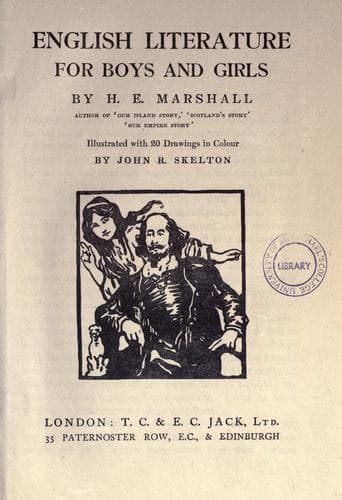
English Literature for Boys and GirlsMarshall, H. E. (Henrietta Elizabeth)
History
English Literature for Boys and Girls
Marshall, H. E. (Henrietta Elizabeth)
English literature -- History and criticism
As it was the times that made More write his book, so it was the
times that gave him the form of it.
In those days, as you know, men's minds were stirred by the
discovery of new lands and chiefly by the discovery of America.
And although it was Columbus who first discovered America, he did
not give his name to the new country. It was, instead, named
after the Italian explorer Amerigo Vespucci. Amerigo wrote a
book about his voyages, and it was from this book that More got
some of his ideas for the Utopia.
More makes believe that one day in Antwerp he saw a man "well
stricken in age, with a black sun-burned face, a long beard, and
a cloak cast homely about his shoulders, whom by his favour and
apparel forthwith I judged to be a mariner."
This man was called Raphael Hythlodaye and had been with Amerigo
Vespucci in the three last of his voyages, "saving that in the
last voyage he came not home again with him." For on that voyage
Hythlodaye asked to be left behind. And after Amerigo had gone
home he, with five friends, set forth upon a further voyage of
discovery. In their travels they saw many marvelous and fearful
things, and at length came to the wonderful land of Nowhere.
"But what he told us that he saw, in every country where he came,
it were very long to declare."
More asked many questions of this great traveler. "But as for
monsters, because they be no news, of them we were nothing
inquisitive. . . .. But to find citizens ruled by good and
wholesome laws, that is an exceeding rare and hard thing!"
The whole story of the Utopia is told in the form of talks
between Hythlodaye, More, and his friend Peter Giles. And More
mixes what is real and what is imaginary so quaintly that it is
not wonderful that many of the people of his own day thought that
Utopia was a real place. Peter Giles, for instance, was a real
man and a friend of More, while Hythlodaye was imaginary, his
name being made of Greek words meaning Cunning Babbler. nearly
all the names of the towns, river, and people of whom Hythlodaye
tells were also made from Greek words and have some meaning. For
instance, Achoriens means people-who-have-no-place-on-earth,
Amaurote a-phantom-city, and so on.
More takes a great deal of trouble to keep up the mystery of this
strange land. It was not wonderful that he should, for under the
pretense of a story he said hard things about the laws and ill-
government of England, things which it was treason to whisper.
In those days treason was a terrible word covering a great deal,
and death and torture were like to be the fate of any one who
spoke his mind too freely.
Public-domain text, read in full here on John Shaqi.
Reviews
Reviews
No reviews yet
Be the first to share your thoughts on this work.
Elsewhere in the archive
Join the Discussion
Join the discussion
Sign in to leave a comment or review.
Sign InorCreate an account